
Best LED downlights can be difficult to identify because an attractive sample, a low quotation, or a familiar brand name does not guarantee stable repeat orders. The risk becomes clearer when specifications change, compliance documents are requested, or a project deadline approaches. I believe buyers need to evaluate the supplier’s ability to deliver the right downlight consistently, not simply find the lowest initial price.
The best LED downlights come from suppliers that can reliably match the buyer’s application, target market, technical specification, compliance needs, customization scope, price position, and delivery plan. There is no single manufacturer that is best for every project. Importers, distributors, local brands, and contractors should compare product consistency, documentation, production discipline, communication, and repeat-order support before selecting a supplier.
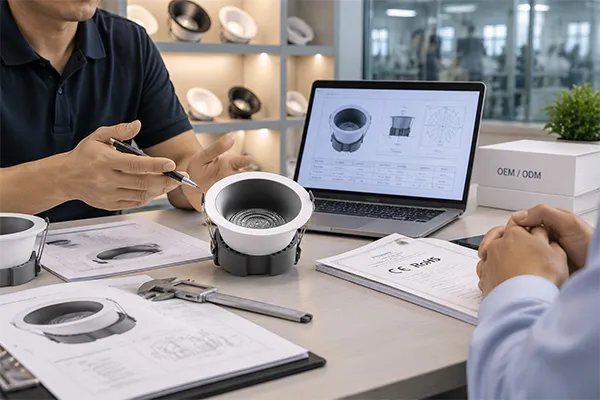
In my OEM/ODM discussions, I see that buyers often begin with a simple question: “Who makes the best LED downlights?” The more useful question is usually more specific. It is about who can make the right downlight for a particular market and continue supplying it with predictable quality, cost, and lead time.
What Defines the Best LED Downlights for a Buyer?
When buyers search for the best LED downlights, they may compare wattage, lumen output, price, or product appearance first. Those points matter, but they can create an incomplete picture. A downlight that looks strong in a catalogue may not suit the installation depth, ceiling material, voltage requirement, or customer expectations in the destination market.
The best LED downlights are those that meet a defined application and procurement standard, including lighting performance, physical fit, compliance documentation, commercial feasibility, and repeat-order consistency. Buyers should assess the complete product-and-supplier package instead of selecting on one specification or one sample alone.
“Best” Depends on the Application
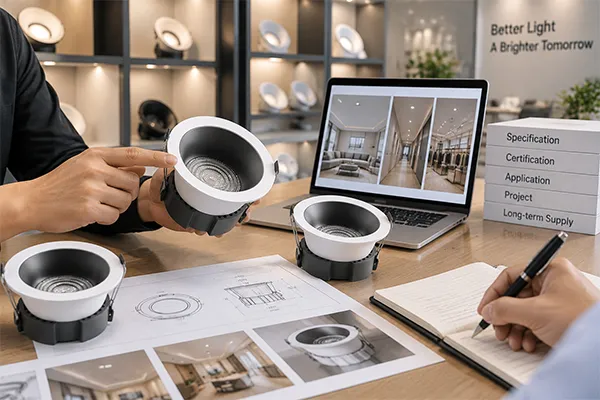
I have learned from customer inquiries that one buyer’s preferred LED downlight can be unsuitable for another buyer’s channel. A distributor serving residential renovation stores may want a compact, cost-conscious recessed downlight with fast-moving color temperatures. A hotel contractor may prioritize visual comfort, consistent finish quality, beam control, and project documentation.
The right evaluation begins with the intended installation.
| Buyer requirement | Questions to confirm | Why it matters |
|---|---|---|
| Ceiling type | Is the ceiling gypsum board, concrete, metal, or another material? | Cutout size, spring design, and installation method may differ.1 |
| Installation depth | How much ceiling void is available? | A deeper driver or heatsink may not fit. |
| Lighting purpose | Is the space residential, retail, hospitality, office, or corridor lighting? | Beam angle, glare control, CRI, and lumen level should match the use case. |
| Electrical conditions | What input voltage and driver configuration are required? | Market compatibility and installation safety depend on this.2 |
| Target price level | Is the product for an entry, mid-range, or premium channel? | Component choices and customization scope affect achievable pricing. |
| Repeat-order plan | Is this a one-off project or a stocked product line? | Long-term supply planning matters more for recurring business. |
Avoid Single-Specification Purchasing
A high lumen number alone does not automatically make a product one of the best LED downlights. Higher output may involve trade-offs in heat management, driver selection, optical design, glare, cost, and operating conditions.3 Similarly, a high CRI request can affect product cost and availability depending on the selected LED source and target specification.4
I recommend that buyers evaluate a downlight as a system:
- Housing and thermal design: Buyers should assess the material, structure, and intended operating conditions.
- LED source and color consistency: Buyers should clarify CCT, CRI, binning expectations, and acceptable variation.
- Optics: Buyers should confirm beam angle, diffuser or reflector style, and visual comfort needs.
- Driver configuration: Buyers should identify whether isolated, non-isolated, dimmable, flicker-sensitive, or other driver requirements apply.
- Installation details: Buyers should verify cutout, outer diameter, height, cable length, connector requirements, and spring strength.
- Documents and market requirements: Buyers should confirm what documents are needed for the destination market and customer channel.
In our pre-sales communication, I often find that the best result comes after a buyer shares the actual project brief, target price, and target market. Those details let us discuss workable options rather than offer a generic “best” answer.
A capable supplier should explain trade-offs clearly. If every specification appears possible at the lowest price and shortest lead time, buyers should ask more questions.
How Should Buyers Compare LED Downlight Manufacturers?
Choosing among LED downlight manufacturers can feel risky when several suppliers offer similar product photos and specification sheets. The real difference may only appear during quotation revisions, sample confirmation, production scheduling, or repeat orders. Buyers need a comparison process that goes beyond promotional claims.
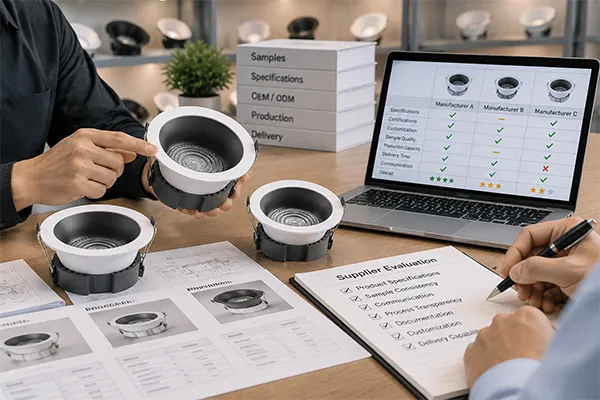
Buyers should compare LED downlight manufacturers through verifiable product specifications, sample consistency, communication quality, process transparency, documentation, customization control, and delivery capability. A supplier’s ability to manage details before production is often a useful indicator of repeat-order reliability.
Compare the Supplier, Not Only the Catalogue
A catalogue is useful for identifying a product family, but it does not show how a manufacturer handles changes or production realities. In my experience, buyers receive better procurement outcomes when they ask practical questions early.
For example, I have seen inquiries where a buyer requested a specific wattage, 3000K and 4000K options, a black finish, branded packaging, and a narrow beam angle. Each request seemed straightforward on its own. Combined, however, those requirements could affect component availability, minimum order quantities, sampling time, unit cost, and the applicability of existing product documents.
A reliable LED downlight manufacturer should be willing to clarify those links before an order is placed.
A Practical Manufacturer Evaluation Checklist
I recommend using a structured comparison sheet for shortlisted suppliers.
| Evaluation area | What buyers should ask | Evidence buyers can request |
|---|---|---|
| Product matching | Can the manufacturer provide the requested wattage, CCT, CRI, beam angle, cutout, and finish? | Datasheet, drawings, sample confirmation, quotation notes |
| Customization management | Which changes are standard and which require new tooling, testing, MOQ, or extra lead time? | Written customization scope and revised specification |
| Quality control | What checks occur before shipment? | Inspection process summary, aging-test process explanation, agreed inspection criteria |
| Documentation | Which certifications or reports are available for the model and market? | Current document copies, model references, issuer details |
| Communication | Are questions answered clearly and consistently? | Quotation accuracy, email records, technical clarifications |
| Supply chain | How are key components managed when demand changes? | Production plan discussion and component lead-time explanation |
| Commercial terms | Are price, MOQ, packaging, payment, and lead time clearly defined? | Formal quotation and pro forma invoice |
| Repeat-order support | Can the supplier maintain approved specifications over time? | Product coding, approved sample process, change-control discussion |
Look for Controlled Communication
For me, quotation quality is not only a sales issue. It is a procurement signal. A detailed quotation should state the product model, specification basis, quantity, price terms, packaging assumptions, lead time, and any important exclusions. A vague quotation can create expensive misunderstandings later.
Buyers should also pay attention to how a supplier responds when requirements are incomplete. A responsible manufacturer should ask follow-up questions about:
- The installation application.
- The destination country or market.
- The required electrical input.
- The preferred CCT, CRI, beam angle, and finish.
- The estimated order quantity and ordering frequency.
- The needed documentation.
- The requested delivery date.
At Upward Lighting, our team supports OEM/ODM discussions for downlights and other LED lighting products. We aim to respond quickly, but I believe speed is most useful when it comes with clear assumptions. A rapid quotation that ignores key details can become less valuable than a slightly slower quotation that prevents a mismatch.
Are OEM and ODM Services Important for the Best LED Downlights?
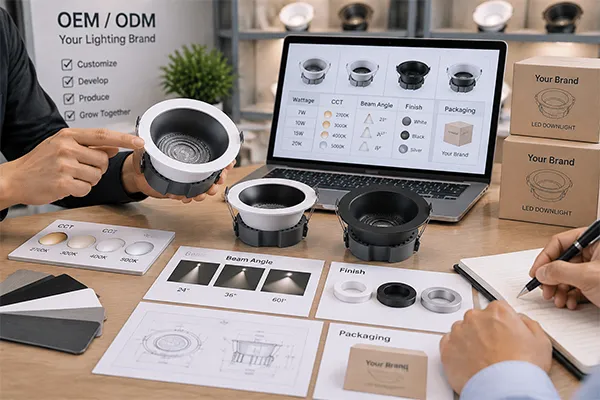
Many importers and local lighting brands want the best LED downlights to reflect their own market position. They may need a different CCT range, a selected beam angle, a black or white surface finish, a branded label, or packaging that fits their sales channel. OEM/ODM services can help, but unmanaged customization can introduce risk.
OEM and ODM services are valuable when customization is technically feasible, commercially justified, documented, and controlled through samples and approved specifications. Buyers should understand that changes to wattage, optics, color, finish, packaging, or electrical configuration may affect cost, MOQ, lead time, product performance, and certification applicability.
Customization Is a Procurement Process
I do not view customization as simply adding a logo. In practical production, each product change needs to be reviewed. For example, changing the outer finish from white to black may require a different surface treatment process or material preparation. Changing from a wide beam to a narrow beam may affect reflector selection and the resulting lighting distribution.5 Changing wattage may require review of the driver, thermal structure, and performance target.6
These are not reasons to avoid customization. They are reasons to manage it properly.
In our OEM/ODM discussions, we commonly receive requests related to:
- Color temperature, such as 2700K, 3000K, 4000K, 5000K, or other agreed options.
- Wattage and target output positioning.
- Beam angle and reflector configuration.
- CRI requirements for different retail or project applications.
- Surface finish colors, including white, black, silver, or project-specific choices.
- Product labels, packaging artwork, manuals, and carton marks.
- Small-batch orders for market testing, where feasible.
Ask What Changes After a Custom Request
Buyers should expect a manufacturer to explain the consequences of each customized requirement. I recommend confirming the following points in writing before final approval:
| Customization item | Typical procurement impact |
|---|---|
| Different CCT | May affect LED source availability, cost, and sample confirmation |
| Higher CRI | May change LED selection, price, and output characteristics |
| Different beam angle | May require another optic or reflector and affect delivery planning |
| New wattage | May require driver and thermal review |
| Finish color | May affect MOQ, surface-treatment cost, and production time |
| Branded packaging | May require artwork approval, printing MOQ, and longer preparation |
| Market-specific electrical design | May affect component configuration and required documents |
A buyer should also distinguish between standard configurable options and a fully new development. A standard option may be available within an existing product platform. A new housing, new cutout, or significantly changed electrical configuration may require more extensive development work.
Samples Should Be Treated as Approval Tools
A sample is important, but buyers should not treat it as the only evaluation point.7 The sample should be linked to an approved specification that defines what the bulk order should follow. I suggest recording:
- Product model and revision
- Wattage and input voltage
- CCT and CRI
- Beam angle
- Finish color
- Cutout and dimensions
- Driver type and dimming requirement, if applicable
- Label and packaging version
- Required documents
- Visual acceptance criteria
This disciplined approach helps buyers pursue the best LED downlights for their own business model rather than buying a generic product that may not support their brand or project needs.
What Quality and Compliance Checks Should Downlight Buyers Verify?
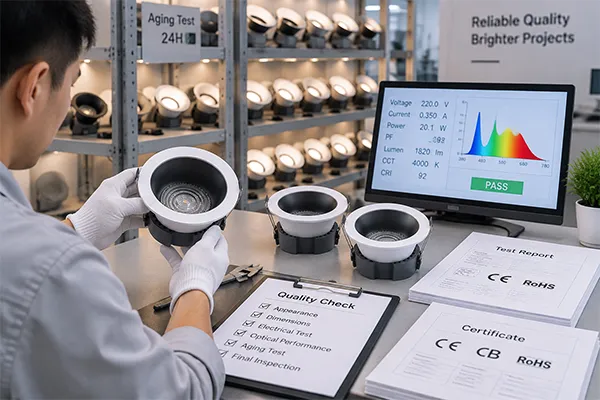
Buyers often ask whether a factory’s aging test proves that its products are the best LED downlights on the market. I think this question needs careful wording. Internal quality procedures can provide useful production information, but they are not the same as independent, long-term lifetime-performance verification.
Downlight buyers should verify quality controls, inspection criteria, product documentation, and certification relevance for their specific model and market. Internal aging tests can be part of a manufacturer’s process discipline, but buyers should not treat them as a substitute for third-party testing, application-specific evaluation, or required regulatory verification.8
Understand What Aging Tests Can and Cannot Show
At Upward Lighting, every product undergoes a 100% aging test lasting between 4 and 8 hours before shipment as part of our stated production process. This process is intended to help identify certain early issues before products leave the factory and to support our internal quality-control workflow.
However, I believe buyers should understand the boundaries of this type of process. A routine aging test does not by itself prove a universal service life, laboratory-grade performance claim, or long-term field outcome under every installation condition.9 Actual results can depend on ambient temperature, wiring conditions, installation quality, operating hours, voltage stability, ventilation, and many other factors.10
A responsible supplier should avoid overstating what internal QC can prove.
Verify Documents by Model and Market
Many buyers require CE and RoHS documentation.11 These documents can be relevant to market entry and customer procurement processes, but requirements should be confirmed for the destination market, the specific product model, and the intended sales channel.
I recommend that buyers verify:
- Whether the document references the correct product or product family.
- Whether the model, electrical configuration, and relevant parameters align with the proposed order.12
- Whether the document is current and comes from an identifiable issuer.
- Whether additional requirements apply in the target market.
- Whether local importers, consultants, contractors, or authorities require further testing or documentation.
At Upward Lighting, we state that our products hold certifications such as CE and RoHS. Buyers should still review the relevant documents for the product they plan to purchase. This is especially important when a standard model is customized.
Build Quality Requirements into the Purchase Order
The most effective quality control starts before mass production. Buyers should define practical acceptance standards in the purchase order, approved sample record, or quality agreement.
Useful criteria may include:
- Correct model, wattage, CCT, CRI, and beam angle
- Approved dimensions and cutout size
- Finish color and visual appearance
- Packaging method and carton markings
- Functional check requirements
- Quantity and spare-parts policy, if applicable
- Document package required with shipment
- Pre-shipment inspection arrangements
- Process for handling approved product changes
For larger projects or higher-risk applications, I recommend qualified professional evaluation. A lighting designer, electrical engineer, local compliance adviser, or third-party inspection provider can help buyers assess application-specific requirements that a general supplier quotation cannot resolve.
Frequently Asked Questions
Is there one company that makes the best LED downlights?
No single company makes the best LED downlights for every buyer and application. The right supplier depends on the target market, required product specification, price level, compliance needs, order volume, customization scope, and repeat-order expectations. Buyers should compare fit and consistency rather than rely only on reputation.
Are expensive LED downlights always better quality?
Higher pricing can reflect different components, designs, documentation, or brand positioning, but price alone does not define quality. Buyers should compare agreed specifications, samples, inspection controls, product documents, and supplier responsiveness. A suitable downlight must match the intended application and commercial plan.
What should I ask an LED downlight manufacturer before ordering?
I recommend asking about model specifications, cutout size, CCT, CRI, beam angle, input voltage, driver options, MOQ, packaging, lead time, customization limits, inspection process, and available documents. Buyers should also ask how specification changes will affect cost, delivery, and documentation.
Can I customize LED downlights with my own brand?
Yes, many manufacturers support OEM or ODM programs that may include labels, packaging, finishes, CCT, wattage, or optical options. Buyers should confirm whether each requested change is a standard option or a new development. MOQ, tooling, pricing, lead time, and document applicability may change.
Does a 4- to 8-hour aging test prove LED downlight lifetime?
No. An internal 4- to 8-hour aging test may be part of routine production quality control and can help identify certain early issues. It does not replace third-party testing, long-term field data, or application-specific assessment. Buyers should verify requirements appropriate to their market and project.
Conclusion
The best LED downlights are not defined by a famous name, the lowest price, or one impressive specification. I believe the strongest choice is a product-and-supplier match that supports the intended application, target market, documentation needs, customization plan, and repeat-order risk. Buyers should verify specifications, review relevant documents, approve samples carefully, and ask how changes affect production. If you are sourcing LED downlights for a distribution line, local brand, or project, contact Upward Lighting to discuss a practical OEM/ODM quotation and specification review.
"recessed luminaire - installation instructions", https://www.kirlinlighting.com/wp-content/uploads/2022/06/760277-RECESSED-LUMINAIRE.pdf. Electrical-safety guidance for recessed luminaires states that installation must follow the luminaire’s listed mounting method and instructions, which can vary with ceiling construction and the product’s required opening and support arrangement. Evidence role: general_support; source type: institution. Supports: Recessed luminaires must be selected and installed according to their mounting method, ceiling construction, and product instructions.. Scope note: Such guidance establishes the need for compatibility but does not prescribe one universal cutout or spring design. ↩
"Electric Power Generation, Transmission, and Distribution eTool", http://www.osha.gov/etools/electric-power/glossary-terms. IEC luminaire and controlgear standards require equipment to be rated and assessed for specified electrical conditions, supporting the need to match input voltage and driver configuration to the intended installation and market. Evidence role: general_support; source type: institution. Supports: Luminaires and controlgear must be used within their specified electrical ratings and installation conditions.. Scope note: Compliance with a standard depends on the particular product, applicable edition, national adoption, and installation. ↩
"[PDF] 2019 Solid-State Lighting R&D Opportunities - Department of Energy", https://www.energy.gov/sites/prod/files/2020/01/f70/ssl-rd-opportunities2-jan2020.pdf. U.S. Department of Energy guidance explains that LED luminaire performance and reliability depend on thermal, electrical-driver, optical, and operating-condition design choices, so higher-output configurations can entail system-level trade-offs. Evidence role: mechanism; source type: government. Supports: LED luminaire output and performance depend on interrelated thermal, electrical, optical, and application conditions.. Scope note: The guidance describes general LED-luminaire design principles and does not evaluate a particular downlight model or price point. ↩
"[PDF] 2019 Solid-State Lighting R&D Opportunities - Department of Energy", https://www.energy.gov/sites/prod/files/2020/01/f70/ssl-rd-opportunities2-jan2020.pdf. DOE LED lighting materials note that improving color-rendering characteristics can involve efficacy and spectral-design trade-offs, which may influence the selection and cost of LED sources. Evidence role: mechanism; source type: government. Supports: Higher-CRI LED products may involve spectral-design and efficacy trade-offs that affect component selection and cost.. Scope note: General technical guidance cannot establish the availability or price of components for a specific supplier, quantity, or date. ↩
"[PDF] CALiPER Application Summary Report 20: LED PAR38 Lamps", https://www1.eere.energy.gov/buildings/publications/pdfs/ssl/caliper_20_summary.pdf. Lighting-engineering references describe beam angle and luminous-intensity distribution as functions of a luminaire’s optical system; changing reflector or lens geometry can therefore alter the distribution produced by a downlight. Evidence role: mechanism; source type: research. Supports: Luminaire optics, including reflectors and lenses, determine beam angle and luminous-intensity distribution.. Scope note: The precise change in distribution depends on the LED package, reflector geometry, diffuser, and measurement method. ↩
"[PDF] LED Dimming: What you need to know - eere.energy.gov", https://www1.eere.energy.gov/buildings/publications/pdfs/ssl/dimming_webcast_12-10-2012.pdf. LED-system research shows that electrical drive conditions affect junction temperature, driver operation, efficacy, and light output, supporting the need to reassess driver and thermal design when a luminaire’s wattage target changes. Evidence role: mechanism; source type: research. Supports: LED drive current and power affect driver requirements, thermal management, and photometric performance.. Scope note: A general relationship between power and thermal/electrical design does not determine whether a particular product revision requires redesign. ↩
"Trade Guide: WTO PSI - International Trade Administration", https://www.trade.gov/trade-guide-wto-psi. International trade and quality-control guidance describes pre-production samples as one element of quality assurance and emphasizes written specifications, in-process controls, and pre-shipment inspection to verify that production conforms to agreed requirements. Evidence role: general_support; source type: government. Supports: Quality assurance for manufactured goods commonly uses specifications, process controls, and inspection in addition to sample approval.. Scope note: The appropriate inspection regime, sampling plan, and acceptance criteria depend on the product risk, contract, and applicable standards. ↩
"[PDF] LED Luminaire Reliability: Impact of Color Shift - Department of Energy", https://www.energy.gov/sites/prod/files/2017/04/f34/lsrc_colorshift_apr2017.pdf. IEC and DOE LED-testing frameworks distinguish routine production screening from standardized performance, reliability, and conformity assessments; an internal burn-in process alone does not establish regulatory compliance or long-term field performance. Evidence role: expert_consensus; source type: institution. Supports: Production screening, reliability testing, and conformity assessment serve different purposes in evaluating LED lighting products.. Scope note: The applicable test and conformity route varies by product type, jurisdiction, and claimed characteristic. ↩
"[PDF] Lighting Designer Roundtable on Solid-State Lighting", http://www1.eere.energy.gov/buildings/publications/pdfs/ssl/designer_roundtable_report_final_apr08.pdf. DOE LED lifetime guidance explains that useful-life projections rely on defined measurement and extrapolation methods and are influenced by operating temperature and system design; a short production burn-in is therefore not direct proof of universal service life. Evidence role: mechanism; source type: government. Supports: LED lifetime claims require defined test methods and are affected by temperature, drive conditions, and luminaire design rather than a brief burn-in alone.. Scope note: Standardized lifetime projections still may not predict every real installation environment or maintenance practice. ↩
"[PDF] Chapter 5: Lighting, HVAC, and Plumbing - eere.energy.gov", https://www1.eere.energy.gov/buildings/publications/pdfs/commercial_initiative/sustainable_guide_ch5.pdf. DOE technical materials identify ambient temperature, thermal path, electrical drive conditions, and application environment as factors affecting LED luminaire light output, color behavior, and reliability. Evidence role: mechanism; source type: government. Supports: Thermal environment and electrical operating conditions influence LED luminaire performance and reliability.. Scope note: The relative importance of each factor depends on the luminaire’s design, installation, and local electrical conditions. ↩
"RoHS Directive - Environment - European Commission", https://environment.ec.europa.eu/topics/waste-and-recycling/rohs-directive_en. European Commission guidance states that CE marking applies where EU harmonisation legislation requires it, while the RoHS framework restricts specified hazardous substances in covered electrical and electronic equipment and requires relevant technical compliance documentation. Evidence role: historical_context; source type: government. Supports: EU CE-marking and RoHS frameworks impose applicable conformity and restricted-substance obligations for covered electrical and electronic equipment.. Scope note: Whether a particular downlight must meet a given EU requirement depends on its classification, supply chain role, and applicable legislation. ↩
"Preparing technical documentation - Your Europe - European Union", https://europa.eu/youreurope/business/product-rules-compliance/general-product-compliance/preparing-technical-documentation/index_en.htm. European Commission conformity-assessment guidance requires technical documentation and EU declarations of conformity to identify the product and support compliance with applicable requirements, making model and configuration alignment material when documents are reviewed. Evidence role: general_support; source type: government. Supports: Conformity documentation should identify the product and demonstrate compliance for the equipment placed on the market.. Scope note: Document-content requirements differ among applicable directives, regulations, and national market-surveillance practices. ↩