Anti-glare LED downlights are becoming a common request in lighting projects because buyers increasingly need more than high lumen figures. A bright ceiling can still create uncomfortable direct brightness, poor visual balance, and a space that feels less refined. I help project teams compare glare control, useful illumination, installation conditions, and budget before selecting a configuration.
Anti-glare LED downlights are popular because they can reduce uncomfortable direct brightness in typical viewing directions while preserving suitable illumination for a space. Their value depends on the complete optical design, room layout, mounting height, task requirements, and installation conditions—not simply on a deep cup, black reflector, or an “anti-glare” product label.
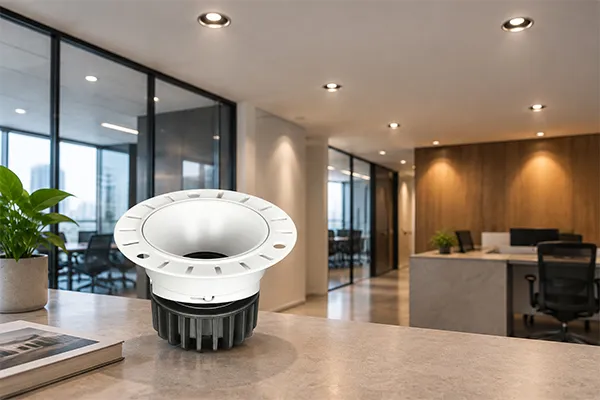
In my pre-sales discussions, I see a clear shift in how contractors, technical leads, and purchasing teams evaluate downlights. They still ask about wattage, lumen output, and price. However, they now also ask where occupants will look, how the ceiling will appear, and whether a proposed layout will feel uncomfortable after commissioning.
Why Do Anti-Glare LED Downlights Improve Visual Comfort?
Many projects begin with a familiar problem: the ceiling plan provides enough brightness on paper, but occupants see harsh points of light when they look across the room. This can make a hotel lobby feel less calm, a retail display less attractive, or an office less pleasant to use.
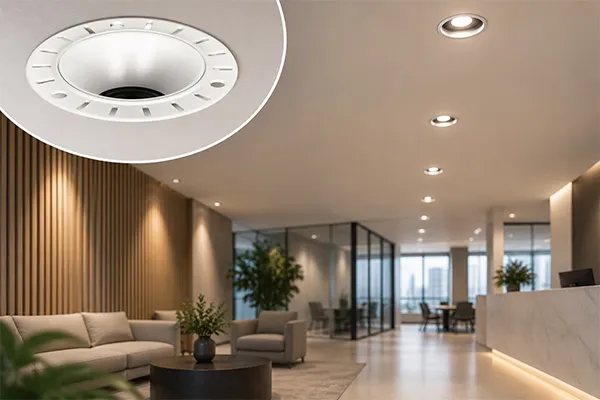
Anti-glare LED downlights can improve visual comfort by shielding the light source from common viewing angles and controlling how light leaves the fixture. A well-selected fitting can reduce excessive direct luminance while still delivering useful light to the intended plane. The result depends on optics, spacing, aiming, mounting depth, and room conditions.
Glare Is More Than “Too Much Brightness”
I usually explain that glare is not the same as illumination. A space may have adequate lux levels on the floor, desk, or counter while still causing visual discomfort1. This often happens when a bright LED source is visible directly from the normal line of sight.
Two broad issues can occur:
- Discomfort glare:2 Users feel irritation or fatigue because a luminaire appears excessively bright.
- Veiling reflections:3 Light reflects from glossy screens, polished floors, display glass, or work surfaces and reduces visual clarity.
- Poor spatial balance: Bright ceiling points can dominate the visual scene, making walls, furniture, and displays appear comparatively dark.
- Uneven perception: A lighting calculation may show acceptable average illumination, while occupants still notice sharp contrast between the source and surrounding ceiling.
A recessed light source, suitable shielding angle, and controlled reflector design may reduce direct visibility of the LED.4 However, I do not treat a deep reflector as proof of low-glare performance. The source position matters. The reflector finish matters. The beam distribution matters. Most importantly, the viewing position matters.
For example, a downlight installed above a reception desk may look comfortable to a person standing below it. The same fixture may be visually prominent to a visitor entering from several metres away. This is why I ask project teams to consider the likely sightlines, not just the ceiling cutout and wattage.
Useful Light Still Matters
Some buyers assume glare control means sacrificing brightness. I do not frame the decision that way. The better question is whether the installation delivers adequate useful illumination where people need it.
A narrow or well-shielded beam may require:
- A different luminaire spacing
- A revised wattage selection
- A higher quantity of fixtures
- Supplementary wall washing or task lighting
- A more precise aiming plan for adjustable models
The correct balance is project-specific. A corridor may need controlled vertical and horizontal illumination for safe movement. A retail shelf may need accent lighting as well as general lighting. A meeting room may need appropriate desk-plane illumination and controlled reflections on screens.
I normally encourage buyers to compare the complete lighting layout rather than comparing only the lumen output printed on a product specification sheet.
What Makes Anti-Glare LED Downlights Different From Standard Downlights?
A common purchasing risk is assuming that every recessed downlight with a black inner cup or deep trim is an anti-glare product. This shortcut can lead to inconsistent visual results, especially when fittings from different suppliers are mixed within one project.
Anti-glare LED downlights differ from standard downlights when their optical and mechanical design deliberately limits direct viewing of the bright source at relevant angles. Deep recesses, shielding elements, reflector geometry, source placement, and beam control can contribute, but no single visible feature guarantees low-glare performance.
Key Optical Features Buyers Should Review
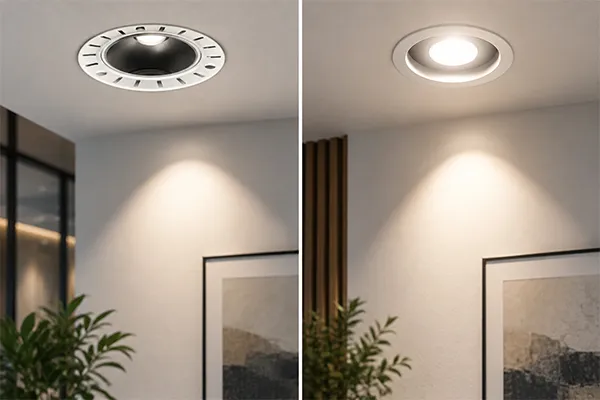
When I review an anti-glare downlight inquiry, I look beyond the product photo. A black reflector can create an attractive visual effect, but the colour itself does not automatically establish optical performance. A white or metallic reflector may also work well when the overall design and application are suitable.
Here are the factors I recommend evaluating:
| Product factor | Why it matters | Buyer question |
|---|---|---|
| Source recess depth | A deeper source position may reduce direct source visibility | How far is the LED source recessed from the ceiling plane? |
| Shielding angle | This indicates how effectively the source may be screened from certain viewing angles | What shielding angle does the design provide, and how was it determined? |
| Beam angle | Beam width affects spacing, uniformity, and task-plane illumination | Is a 24°, 36°, 60°, or wider beam suitable for the layout? |
| Reflector design | Reflector geometry influences intensity distribution and visual appearance | Is the reflector designed for general lighting, accent lighting, or wall washing? |
| LED source position | Source placement changes how bright the fitting appears from outside the beam | Can the source be seen from typical seated and standing positions? |
| Trim and installation depth | Ceiling details affect both appearance and source shielding | Will the ceiling construction preserve the intended recessed effect? |
Product Appearance and Performance Are Different Questions
I have seen customers focus heavily on black inner reflectors because they create a premium, quiet-looking ceiling. This can be a valid design preference. In hospitality, luxury residential, and boutique retail projects, the visual appearance of the unlit luminaire can matter a great deal.
Still, I separate two questions:
- Does the fixture create the desired ceiling appearance?
- Does the installed lighting system control glare while meeting illumination needs?
A fitting may answer the first question well but need further evaluation for the second. I recommend that buyers request photometric data where available, review the proposed layout, and inspect samples in a representative ceiling mock-up when the project has demanding visual requirements.
At Upward Lighting, we can discuss variables such as wattage, beam angle, colour temperature, CRI, and surface finish for OEM/ODM projects. However, I would still advise a qualified lighting professional to verify application-specific performance for complex spaces or formal compliance requirements.
Which Spaces Need Anti-Glare LED Downlights Most?
A universal low-glare specification can create unnecessary cost in some areas and insufficient comfort in others. Project teams often need to decide where glare control has the strongest value rather than applying the same fixture throughout an entire building.
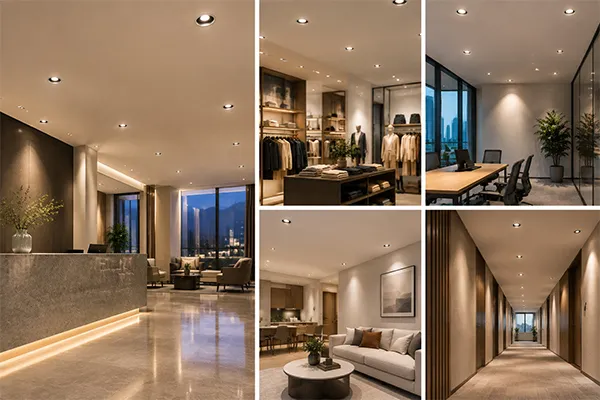
Anti-glare LED downlights are most relevant in spaces where people spend time looking across the room, working under ceiling lighting, viewing reflective surfaces, or expecting a refined visual atmosphere. Residential, hospitality, retail, office, and circulation areas require different priorities for comfort, uniformity, accent, and cost.
Residential and Hospitality Spaces
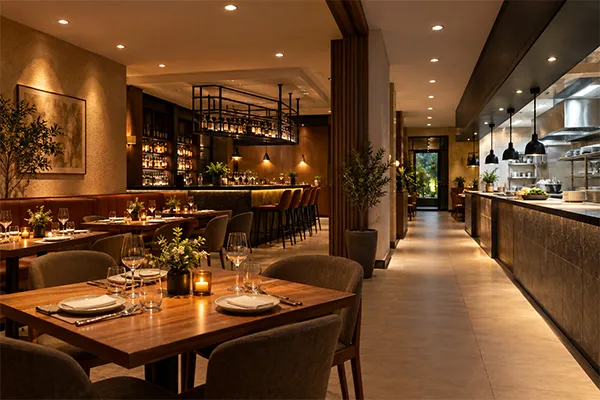
In residences, hotels, restaurants, and lounges, occupants often notice the ceiling from seated positions. They may look toward downlights while dining, relaxing, or speaking with others. A harsh visible source can distract from the interior design.
I often discuss these considerations with customers:
- Use warmer colour temperatures where the design concept calls for a more relaxed atmosphere.
- Choose beam angles based on ceiling height, furniture layout, and focal areas.
- Use anti-glare recessed downlights for general ambience, while adding decorative or task lighting where necessary.
- Check whether deep fixtures can fit within the ceiling void.
- Avoid over-lighting. More fixtures or more watts do not automatically create a better hospitality experience.5
Retail and Display Areas
Retail lighting has a different challenge. The project may need bright vertical illumination on merchandise, stronger accents on focal displays, and comfortable general circulation lighting at the same time.
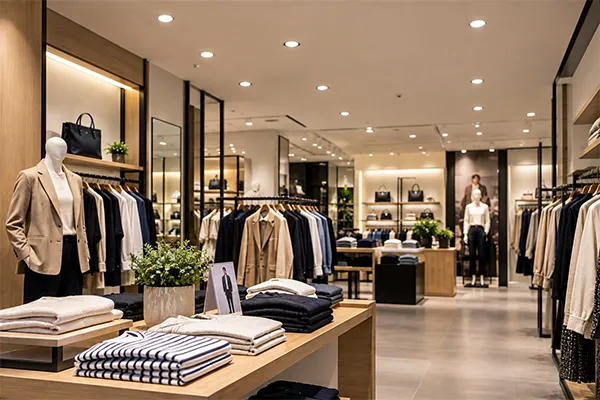
A low-glare recessed fitting may be useful in customer circulation zones, fitting rooms, or general ceiling grids. However, a retail team may still need adjustable spotlights or track fixtures for merchandise. I would not recommend relying on one downlight type to solve every retail lighting task.
Offices and Meeting Rooms
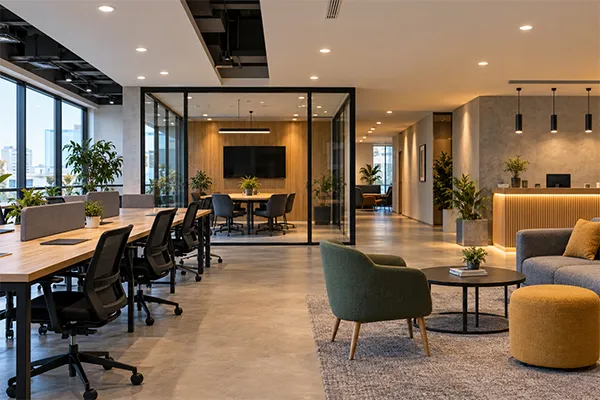
Office users may spend many hours looking at screens, documents, and colleagues.6 Glare control can therefore be important, but the specification should consider screen placement, desk layouts, ceiling height, daylight, and required task illumination.
For office projects, I suggest that technical teams examine:
- Desk-plane illumination targets
- Screen reflections and monitor orientation
- Luminaire spacing and mounting height
- Surface reflectance of ceilings, walls, and desks
- The need for linear lighting, indirect lighting, or task lighting alongside downlights
Corridors, Entrances, and Circulation Zones
Circulation areas usually require safe, consistent navigation. Anti-glare LED downlights may help create a calmer ceiling appearance in hotel corridors, apartment lobbies, clinics, and premium commercial entrances.
However, these areas often have long sightlines. Fixture spacing, beam overlap, and wall brightness may matter as much as the downlight itself. I have seen corridor concepts where closely spaced narrow beams created visible bright spots and dark gaps. A wider beam, revised spacing, or supplementary wall lighting may provide a more balanced result.
How Should Buyers Evaluate UGR Claims for Anti-Glare LED Downlights?
UGR figures can appear reassuring on product catalogues, but they can also be misunderstood. Buyers may see a “UGR <19” statement and assume that the same result will apply in every room, ceiling height, and layout. In practice, glare evaluations depend on the installation.
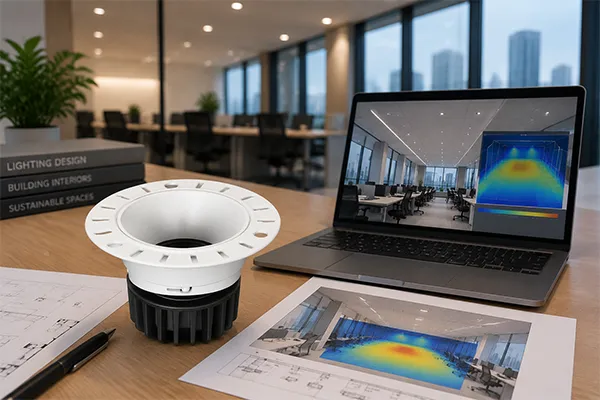
Buyers should treat UGR claims for anti-glare LED downlights as conditional technical evidence rather than a standalone purchasing shortcut. A meaningful UGR assessment requires the relevant room geometry, surface reflectance, luminaire photometry, mounting height, spacing, viewing direction, and operating conditions.7
What UGR Can and Cannot Tell You
Unified Glare Rating, commonly called UGR, is a method used to estimate discomfort glare under defined conditions.8 It can be useful during lighting design, particularly in workspaces where visual comfort requirements are specified.
However, a UGR value is not a permanent label attached to a fixture in isolation. The calculated result can change with:9
- Room length, width, and height
- Ceiling, wall, and floor reflectance
- Luminaire position and spacing
- Mounting height
- Number of luminaires
- Photometric file used in the calculation
- Observer position and viewing direction
- Output level and dimming state
This is why I encourage buyers to ask suppliers and lighting designers what supports the stated claim. A responsible discussion should include the calculation assumptions, not only the headline number.
Questions I Ask Before Discussing a UGR-Sensitive Project
When a customer requests “UGR 19 downlights,” I usually ask for more context before recommending a model:
- What type of space is it: office, classroom, showroom, lobby, corridor, or residence?
- What are the room dimensions and finished ceiling height?
- What is the required illumination level on the relevant task plane?
- What is the planned fixture spacing and layout?
- Where will users normally sit, stand, or look?
- Are screens, glossy displays, glass, or polished surfaces present?
- Is there a lighting calculation, reflected ceiling plan, or photometric requirement?
These questions are not obstacles to a quotation. They reduce the risk of supplying a product that looks correct in a catalogue but performs poorly after installation.
I can provide product information and discuss available configurations, but a qualified lighting designer or engineer should verify final project calculations and compliance obligations.
Documentation Should Be Verified
For projects that require formal documentation, buyers should request and verify relevant technical materials. Depending on the market and application, this may include photometric files, product datasheets, test reports, installation instructions, and certification documents.
At Upward Lighting, our products can be supplied with CE and RoHS documentation for applicable market-entry requirements. I recommend that buyers verify the validity, scope, and relevance of all documents for their target market and exact product configuration. Certification documents do not replace a project-specific lighting design review.10
How Can Buyers Source Anti-Glare LED Downlights With Lower Project Risk?
Supplier selection becomes important when a project needs consistent colour, beam performance, finish quality, delivery reliability, and documentation. A sample that looks good on a showroom table may not represent the final installed batch without proper quality controls.
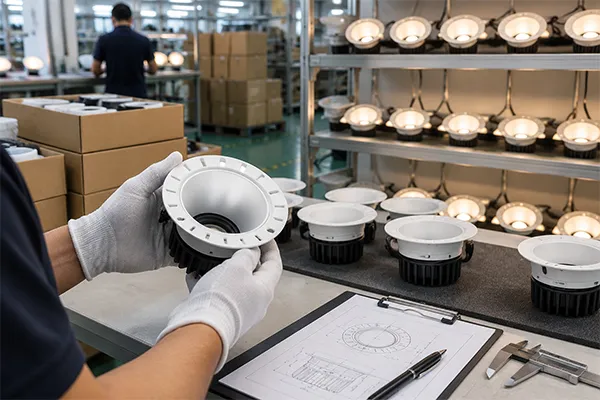
Buyers can reduce risk when sourcing anti-glare LED downlights by evaluating samples, optical options, production controls, documentation, customization capability, and communication speed. They should confirm that the proposed model matches the approved beam angle, wattage, colour temperature, trim finish, cutout, and installation conditions before bulk production.
Build a Practical Approval Process
I recommend a staged process for contractors, importers, and lighting brands:
- Define the application. Confirm room use, ceiling height, desired atmosphere, task requirements, and budget.
- Select preliminary optics. Compare beam angles, wattage ranges, source recess, trim options, and colour temperature.
- Review samples. Inspect the fixture both when switched off and illuminated. Check common viewing angles.
- Confirm installation details. Verify cutout size, ceiling thickness, driver location, heat dissipation space, IP requirement, and access for maintenance.
- Approve a reference sample. Record the agreed specifications, including CCT, CRI, beam angle, housing colour, and packaging requirements.
- Verify production controls. Ask how the supplier manages aging tests, incoming materials, visual inspection, and batch consistency.
- Check shipment documentation. Match product labels, carton marks, certification documents, and purchase order details before dispatch.
Questions Worth Asking a Downlight Supplier
During sourcing discussions, I find that practical questions often reveal more than broad claims:
- Can the supplier provide small-batch orders for a pilot installation?
- Can the supplier customize CCT, wattage, CRI, beam angle, and trim colour?
- Is the driver specification clear and suitable for the target market?
- Does the fixture require a particular ceiling depth?
- What is the stated aging-test process?
- How will the supplier control colour consistency across repeat orders?
- What is the quotation lead time and production lead time?
- What documents are available for the exact model being purchased?
At Upward Lighting, we carry out a 100% aging test before shipment, typically for 4 to 8 hours, as part of our internal quality process. I describe this as a manufacturing control, not as a substitute for independent lifetime testing or final site verification. Buyers should still inspect samples and confirm that the selected configuration suits their installation.
I have found that early technical communication prevents many avoidable problems. A contractor who shares the ceiling plan, mounting height, and target atmosphere early usually receives a more suitable recommendation than one who requests only “black anti-glare downlight, best price.”
Frequently Asked Questions
Are anti-glare LED downlights less bright?
Anti-glare LED downlights are not automatically less useful or less bright. Their optics may reduce direct source visibility while directing light toward the intended area. The final illumination depends on wattage, beam angle, mounting height, spacing, room surfaces, and the overall lighting layout.
Does a black reflector guarantee an anti-glare downlight?
No. A black reflector may reduce the visual brightness of the inner cup and create a premium appearance, but it does not guarantee low-glare performance. Buyers should also assess source recess depth, shielding angle, beam distribution, installation height, and typical viewing positions.
What UGR should I request for office downlights?
The appropriate UGR target depends on local standards, the work performed, room geometry, and the lighting design. Buyers should not request a UGR figure without a relevant calculation. A qualified lighting professional should assess the final layout, photometry, viewing conditions, and task requirements.
Can I use anti-glare LED downlights in a retail store?
Yes, anti-glare LED downlights can work well for general retail lighting and customer circulation areas. However, many stores also need adjustable accent lighting or track lights to highlight merchandise. The correct mix depends on ceiling height, product displays, brand atmosphere, and lighting targets.
What should I check before ordering anti-glare downlights in bulk?
I recommend checking the approved sample, wattage, lumen output, beam angle, CCT, CRI, cutout size, trim finish, driver, IP rating, installation depth, documentation, and production lead time. Buyers should also confirm quality-control procedures and evaluate the fixture in a representative project setting when possible.
Conclusion
Anti-glare LED downlights are becoming popular because lighting buyers now recognize that high lumen output alone does not guarantee a successful space. I recommend evaluating source shielding, beam distribution, layout, mounting conditions, task-plane illumination, and normal viewing angles together. A deep cup or black reflector can support the desired effect, but neither guarantees low glare. If you are sourcing a project-specific downlight solution, I invite you to share your ceiling plan, application, and target specifications with Upward Lighting so we can help you compare suitable OEM/ODM options.
"Adjustable task lighting: Field study assesses the benefits ...", https://pubmed.ncbi.nlm.nih.gov/24939117/. Lighting research and design guidance treat task-plane illuminance and discomfort glare as separate aspects of lighting quality; compliance with an illuminance target alone does not ensure visual comfort. Evidence role: general_support; source type: research. Supports: That task-plane illuminance and discomfort glare are distinct lighting-performance measures, so adequate illuminance does not by itself ensure visual comfort.. Scope note: The applicable illuminance and glare criteria vary by task, jurisdiction, and design standard. ↩
"Glare (vision)", https://en.wikipedia.org/wiki/Glare_(vision). The International Commission on Illumination defines discomfort glare as glare that causes visual discomfort without necessarily impairing the ability to see. Evidence role: definition; source type: institution. Supports: A lighting authority's definition of discomfort glare as visual discomfort caused by excessive luminance, luminance contrast, or unsuitable luminaires.. ↩
"5 Considerations Concerning Lighting Systems | FHWA", https://highways.dot.gov/safety/other/visibility/fhwa-lighting-handbook-august-2012/5-considerations-concerning-lighting. Lighting and visual-performance literature describes veiling reflections as reflected luminance that can reduce task contrast and thereby diminish visual clarity. Evidence role: mechanism; source type: research. Supports: That reflected luminance, often called veiling reflection or reflected glare, can reduce contrast and impair the visibility of visual tasks.. Scope note: The extent of impairment depends on surface properties, viewing geometry, and the visual task. ↩
"Shielding angle", https://www.neumueller.com/en/services/knowledge/led-lighting/glossary/shielding-angle. Lighting-design guidance explains that shielding angle, source recess, and optical control influence whether a luminaire's bright source is visible from normal viewing directions. Evidence role: mechanism; source type: education. Supports: That luminaire shielding geometry and source position affect the visibility of bright emitting areas and perceived glare.. Scope note: These design features do not alone establish a low-glare result for every room layout or observer position. ↩
"Analysis of factors affecting visual comfort in hotel lobby - PMC", https://pmc.ncbi.nlm.nih.gov/articles/PMC9851505/. Research on lighting quality indicates that visual comfort and environmental appraisal depend on factors including luminance distribution and glare as well as illuminance, so additional light quantity does not inherently improve a space. Evidence role: general_support; source type: research. Supports: That perceived lighting quality and visual comfort depend on distribution, luminance balance, glare, colour, and task suitability in addition to light quantity.. Scope note: Hospitality preferences and target light levels remain dependent on the design brief, activities, and local standards. ↩
"eTools : Computer Workstations - Workstation Environment", http://www.osha.gov/etools/computer-workstations/workstation-environment. Occupational display-screen guidance recognizes computer-screen and document work as sustained visual tasks and addresses lighting and reflections as workstation conditions affecting users. Evidence role: general_support; source type: government. Supports: That office and display-screen work involves sustained visual tasks using screens and documents, for which workstation visual conditions are relevant.. Scope note: Office duties differ substantially by role and workplace design. ↩
"Calculation and Presentation of the Standard CIE UGR ...", https://www.academia.edu/9504476/Calculation_and_Presentation_of_the_Standard_CIE_UGR_Table_for_Indoor_Lighting_Luminaires. CIE guidance on the Unified Glare Rating method calculates discomfort glare from luminaire luminance and solid angle together with background luminance and observer-related room geometry. Evidence role: mechanism; source type: institution. Supports: The calculation inputs and installation-dependent nature of the Unified Glare Rating method.. Scope note: A reported UGR is a result for specified calculation assumptions rather than an intrinsic, universal property of a luminaire. ↩
"UGR", https://en.wikipedia.org/wiki/UGR. The Unified Glare Rating is a CIE-based method for assessing the likelihood of discomfort glare in an interior lighting installation under defined observer and environmental conditions. Evidence role: definition; source type: institution. Supports: The definition of UGR as a standardized method for evaluating discomfort glare in an interior lighting installation.. Scope note: UGR is principally a calculated assessment and does not encompass every aspect of subjective visual comfort. ↩
"Calculation and Presentation of the Standard CIE UGR ...", https://www.academia.edu/9504476/Calculation_and_Presentation_of_the_Standard_CIE_UGR_Table_for_Indoor_Lighting_Luminaires. Studies applying the UGR method show that calculated glare ratings vary with luminaire luminance and arrangement, room reflectances and geometry, and the observer's position and direction of view. Evidence role: mechanism; source type: paper. Supports: That UGR values are sensitive to the geometric, photometric, reflectance, and observer assumptions used in a lighting calculation.. Scope note: The magnitude of each variable's effect depends on the particular luminaire and room. ↩
"Chapter 6 - Lighting - California Energy Commission", https://www.energy.ca.gov/filebrowser/download/5128. Lighting standards and conformity guidance distinguish product-level documentation from project-level assessment: certification can address specified product characteristics, whereas installation performance requires a design review using the actual space, layout, and operating conditions. Evidence role: expert_consensus; source type: institution. Supports: That product conformity or certification addresses specified product requirements and is distinct from demonstrating that a completed lighting installation meets project-specific design requirements.. Scope note: The exact documentation and compliance pathway depend on the applicable jurisdiction, standard, and project contract. ↩