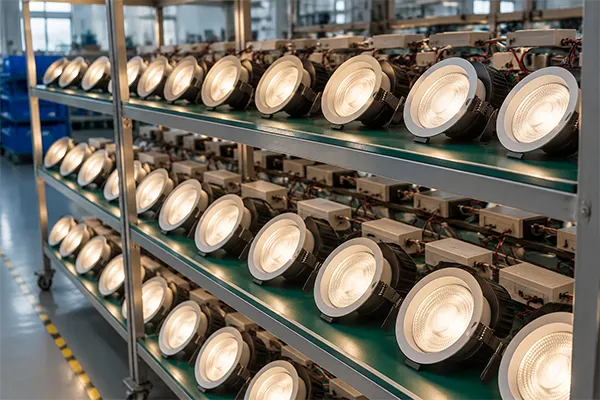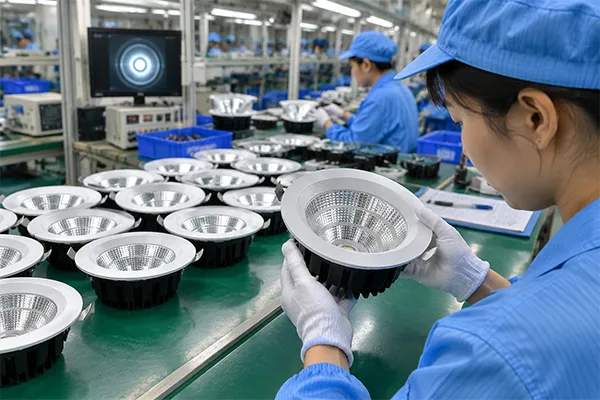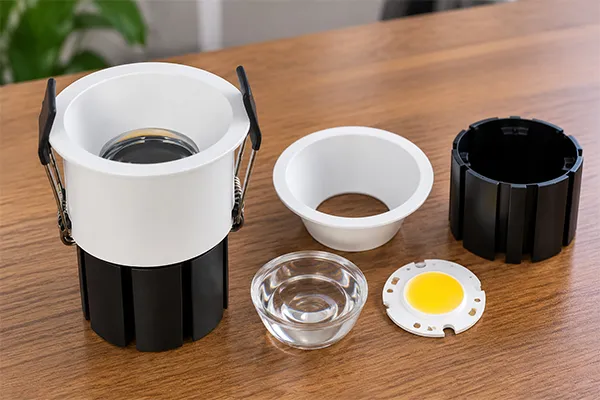
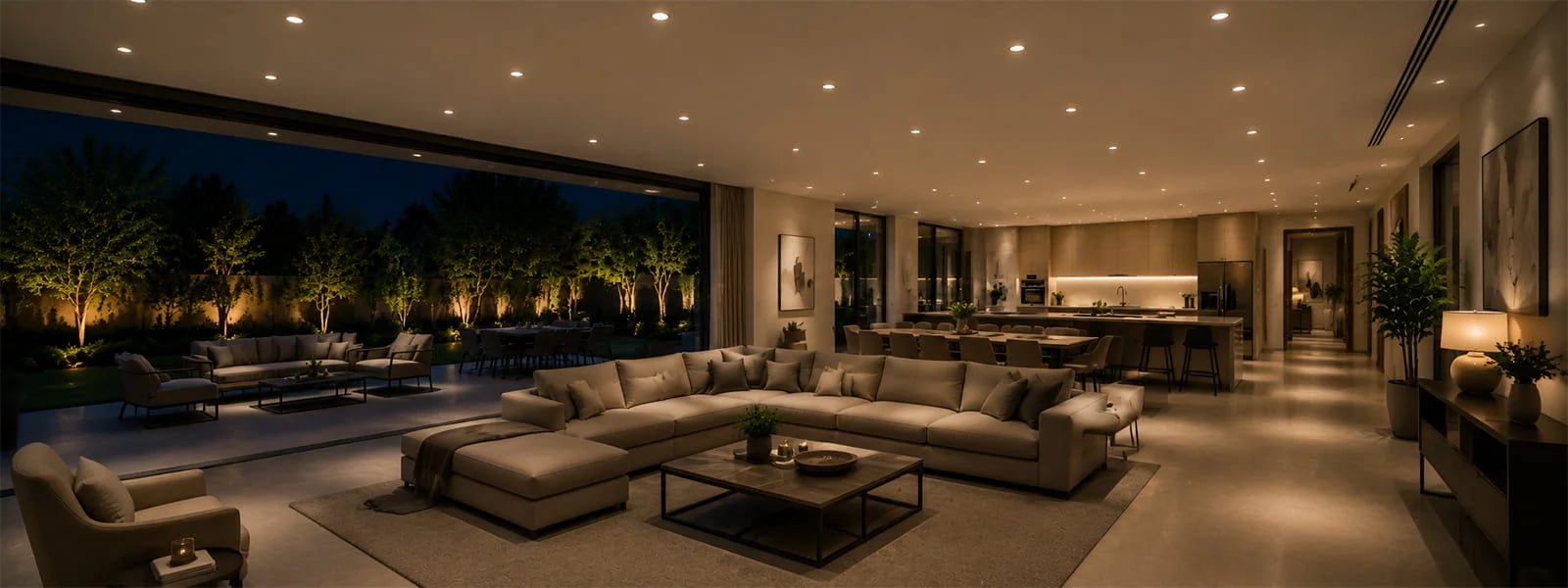
OEM LED downlight manufacturers can help global brands turn broad product ideas into defined, manufacturable lighting products. A logo on a box is easy to request, but an unsuitable beam angle, color temperature, output, or finish can lead to costly returns and customer complaints1. We see the best outcomes when brands start with the application, target buyer, and market position before they finalize specifications.
Global brands choose OEM LED downlight manufacturers because they need more than private-label packaging. They need a supplier that can help convert application requirements into practical specifications for wattage, color temperature, beam angle, CRI, trim finish, packaging, and product positioning. This collaborative process can reduce the risk of launching LED downlights that look right in a catalog but perform poorly in the intended market or installation environment.
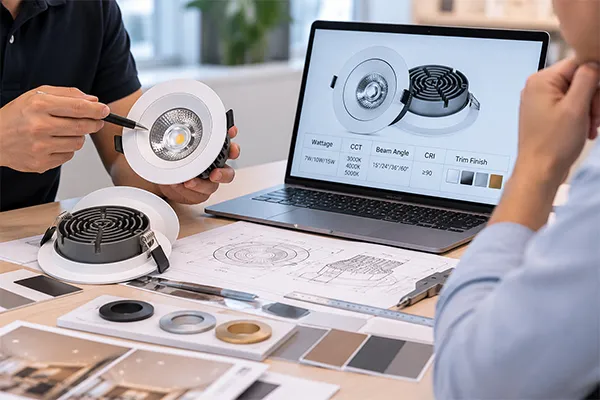
At Upward Lighting, we have supported overseas lighting brands, importers, and project-focused customers with private-label discussions since our early years in LED manufacturing. In those conversations, we have learned that the first question should rarely be, “Can you put our logo on this downlight?” The better question is, “What must this downlight achieve for our customer?”
What Do OEM LED Downlight Manufacturers Actually Do?
Many buyers approach OEM LED downlight manufacturers with a simple request: use an existing model, add a logo, and create custom packaging. That approach can work for some established products, but it creates risk when the product’s core lighting performance does not match the brand’s target application.
OEM LED downlight manufacturers help brands define and produce a product that fits a commercial purpose. Their role may include reviewing the intended installation, suggesting available parameter options, confirming manufacturability, arranging private-label packaging, and producing the selected configuration. The strongest OEM process begins with product definition—not decoration.
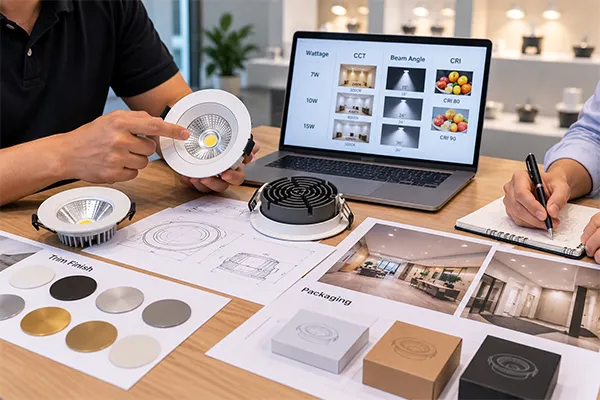
OEM Is More Than Logo Printing
Private labeling is one part of OEM work, but it is not the whole process. A downlight range needs a specification that installers, distributors, sales teams, and end users can understand.
In our experience, a brand may begin with a request such as:
“We need a modern recessed LED downlight for our market, with our own packaging.”
That request gives us a starting point, but it does not yet define a viable product. We still need to understand questions such as:
- Is the downlight intended for homes, retail stores, offices, hotels, or project channels?
- Does the brand need a compact domestic-style downlight or a deeper commercial recessed fitting?
- What cutout sizes are common in the target market?
- Does the customer expect warm white, neutral white, or cool white lighting?
- Is visual comfort a priority?
- Does the product need a narrow, medium, or wide beam?
- Is the buyer competing on price, design, light quality, or a balance of these factors?
- Will the product be sold through wholesalers, electrical channels, online retail, or project tenders?
These questions help move the conversation from a catalog selection to a product-definition exercise.
The Specification Areas That Usually Matter
A practical OEM brief for a downlight often includes the following areas:
| Specification area | Why it matters to the brand | Example decision |
|---|---|---|
| Wattage and lumen output | Affects brightness, energy positioning, and price level | 7W residential model versus 15W commercial model |
| [Color temperature | Shapes the atmosphere and customer expectations](https://en.wikipedia.org/wiki/Color_temperature)%%%FOOTNOTE_REF_2%%% | 3000K for warm hospitality settings; 4000K for many workspaces3 |
| [Beam angle | Influences light distribution and visual comfort](https://www.energy.gov/cmei/ssl/glare)%%%FOOTNOTE_REF_4%%% | Narrower beam for accent lighting; wider beam for general lighting |
| [CRI | Affects color appearance of people, finishes, and merchandise](https://en.wikipedia.org/wiki/Color_rendering_index)%%%FOOTNOTE_REF_5%%% | Standard CRI or higher-CRI positioning |
| Cutout size | Determines installation compatibility | Match common ceiling cutouts in the target channel |
| Trim and finish | Supports visual identity and interior design trends | White, black, gold, or custom surface finish |
| Driver and electrical setup | Affects system compatibility and product construction | Driver type based on the selected model and market needs |
| Packaging | Protects the product and supports the brand story | Private-label box, barcode, instruction insert, carton marking |
We do not treat every combination as automatically feasible or commercially sensible. Some configurations may require different tooling, component changes, higher minimum order quantities, or additional validation. A responsible OEM discussion should make those trade-offs visible early.
Why Is Product Definition More Important Than the Initial Unit Price?
A low initial quotation can look attractive, especially when a brand is introducing a new LED downlight range. However, a low unit price offers limited value if the product is not suitable for the way customers will use, compare, install, or resell it.
The best OEM LED downlight manufacturers help buyers evaluate total product risk, not only the ex-factory price. A downlight that has the wrong beam angle, color temperature, output level, cutout size, or appearance can create complaints, slow sales, rework costs, and damage to brand confidence after launch.
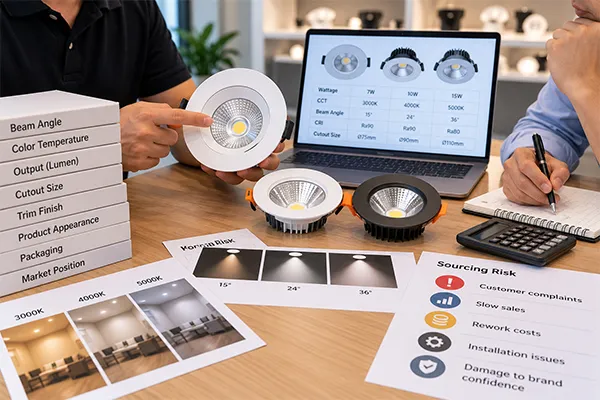
The Cost of a Mismatched LED Downlight
Product-market mismatch is often more expensive than buyers expect. The issue may not appear during a sample review because a sample is usually assessed in isolation6. Problems often become clearer after a product enters a real ceiling, retail environment, showroom, home, or project site.
For example, a downlight can be technically functional but still disappoint customers because:
- The beam spread creates uneven lighting across a room.7
- The color temperature feels too cold or too warm for the intended environment.
- The output is lower or higher than users expect from the product’s positioning.
- The trim style does not match local interior trends.
- The cutout size causes installation complications.8
- The product appearance differs from the brand’s existing range.
- The packaging does not provide clear enough product information for distributors or installers.
I have seen conversations where a buyer initially asked for “the lowest-cost 12W downlight.” Once we discussed the planned application, it became clear that the product would be used in a customer-facing retail environment. The buyer then needed to consider light distribution, visual appearance, color rendering expectations, and the look of the ceiling trim—not only wattage.
That does not mean every project requires the highest specification. It means the specification should support the intended product position.
Evaluate Total Cost, Not Only Purchase Cost
A buyer can use a simple procurement framework to compare offers:
| Cost or risk category | Questions to ask |
|---|---|
| Initial purchase cost | What is the unit price at the expected order quantity? |
| Product fit | Does the model match the application and customer expectation? |
| Installation risk | Does the cutout, depth, wiring arrangement, and trim design suit the channel? |
| Brand risk | Will the product look and perform consistently with the brand’s promise? |
| Rework exposure | Could specification errors require relabeling, repackaging, replacement, or redesign? |
| Supply continuity | Can the supplier communicate lead times, component changes, and repeat-order requirements clearly? |
| Documentation | Can the supplier provide relevant product information and certification documents for buyer review? |
For brands, the objective is not to eliminate every risk. That is rarely realistic in product development. The objective is to identify the important risks before production, when corrections are usually easier and less expensive.
How Do OEM LED Downlight Manufacturers Turn Vague Requests Into Specifications?
A vague request is normal at the beginning of a private-label project. Brand owners often understand their customers well, but they may not have every technical parameter defined. The value of experienced OEM LED downlight manufacturers is often visible in the questions they ask before they issue a final quotation.
OEM LED downlight manufacturers should translate broad product requests into a written, reviewable specification. They do this by clarifying the application, target customer, installation conditions, desired visual effect, price position, packaging needs, and expected order volume. This process helps both the buyer and manufacturer identify practical options before production begins.
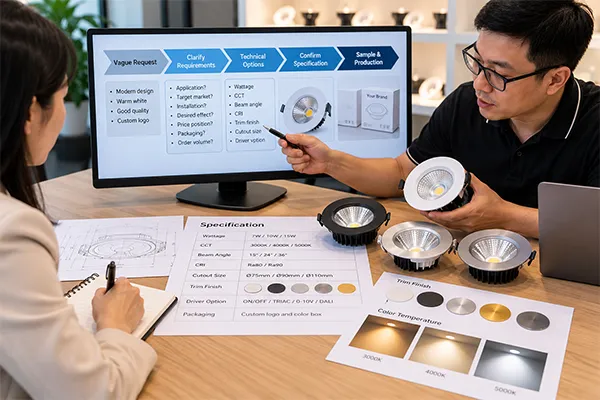
Start With the Application, Not the Model Number
When a buyer sends us a model number from a catalog, we can certainly discuss that model. However, we usually learn more when we ask how the product will be used.
A useful project discussion often starts with five areas:
-
Target application
Is the downlight intended for a residence, hotel, shop, office, corridor, showroom, or mixed-use project? -
Target customer
Is the product aimed at a contractor, distributor, electrician, homeowner, architect, or retail buyer? -
Commercial position
Is the range designed as an entry-level value product, a mid-market line, or a more design-led offering? -
Product requirements
What wattage range, color temperature, beam angle, CRI, finish, and cutout dimensions are preferred? -
Order and branding requirements
Does the brand need custom boxes, labels, instruction sheets, carton marks, barcodes, or small-batch support?
This sequence prevents an early conversation from becoming too narrow. It also helps the buyer compare different product paths based on the same commercial objective.
An Example of Clarifying a Broad Request
A typical anonymized conversation may begin like this:
“We need a black recessed LED downlight for a new premium range.”
That statement is useful, but it leaves many decisions open. We may then ask whether the product is for residential renovation, hospitality projects, or retail display areas. We may ask whether the black finish is only aesthetic or whether the customer also expects anti-glare performance. We may ask which color temperatures the brand plans to stock and whether the channel has preferred cutout sizes.
After clarification, the requirement may become more actionable:
- Recessed LED downlight for boutique retail and residential projects
- Black trim to match contemporary interiors
- Warm white and neutral white options
- Medium beam angle for general and feature lighting
- Higher-CRI option under consideration for color-sensitive displays
- Private-label retail packaging
- Small initial order for market validation, followed by repeat orders if the line performs as expected
This is not a laboratory design process, and we do not claim to replace a project lighting designer or local compliance advisor.9 However, a structured OEM conversation gives brands a clearer basis for deciding what to sample, specify, and launch.
Put the Approved Specification in Writing
Before mass production, buyers should consolidate important decisions in a product specification sheet or approval record. This document can include:
- Product model and product photos
- Dimensions and cutout size
- Wattage and stated output parameters
- Color temperature options
- Beam angle
- CRI requirement
- Housing color and surface finish
- Driver configuration
- Packaging artwork and carton requirements
- Label details and barcode information
- Required documents for buyer review
- Sample approval reference
- Production lead-time expectations
Written approval does not guarantee that every commercial outcome will be perfect. It does, however, create a shared reference point between the brand and the manufacturer.
What Should Brands Ask OEM LED Downlight Manufacturers Before Choosing One?
Choosing among OEM LED downlight manufacturers can feel difficult because many suppliers can provide similar catalog photos, broad customization claims, and competitive quotations. The meaningful differences often appear in how clearly a manufacturer handles specification questions, samples, quality processes, and repeat-order communication.
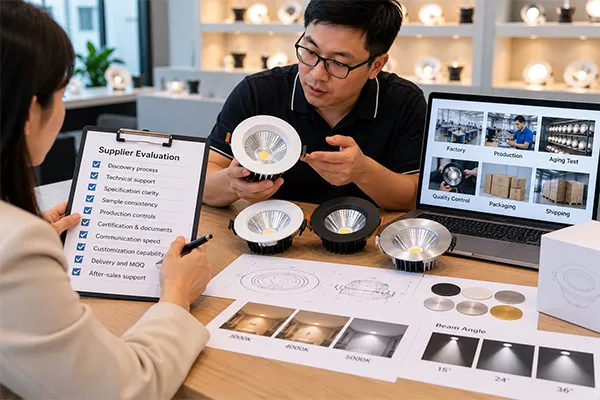
Brands should evaluate OEM LED downlight manufacturers by the quality of their discovery process, documentation, sample consistency, production controls, communication speed, and willingness to explain trade-offs. A suitable supplier should ask relevant questions before recommending a model, rather than promising every option without reviewing the practical details.
Questions for Supplier Selection
I recommend that buyers use a consistent supplier-evaluation checklist. This approach makes it easier to compare quotations on more than price.
| Evaluation area | Questions for the manufacturer |
|---|---|
| Product understanding | What questions do you ask about the intended application and target market? |
| Customization scope | Which parameters can you customize within existing product platforms? |
| Commercial practicality | What minimum order quantities, tooling needs, or lead-time changes apply? |
| Sampling process | How are samples configured, documented, and approved before production? |
| Quality control | What checks are completed during and before shipment? |
| Aging test | How long is the aging process for the selected product, and how is it recorded? |
| Documentation | Which certification documents, test reports, datasheets, and packaging files can be provided for review? |
| Communication | Who handles quotations, technical clarification, artwork, and production updates? |
| Repeat orders | How are component changes, specification revisions, and ongoing supply handled? |
At Upward Lighting, we conduct a 100% aging test before shipment, typically lasting 4 to 8 hours depending on the product and order requirements. Buyers should still ask how any supplier applies its quality procedures to the exact model they are considering. A general factory statement is less useful than a product-specific explanation.
Verify Certifications and Market Requirements Case by Case
Certification is an important sourcing topic, but buyers should not treat a certificate name as a complete answer. Requirements can vary by market, customer, project type, product configuration, and sales channel.10
For example, our products may be supplied with documents such as CE and RoHS documentation where applicable. However, each buyer should verify that the documents, product configuration, labeling, declarations, and any project-specific requirements match the intended destination and application.
Brands should consider asking:
- Does the document apply to the exact product family and configuration?
- Is the document current and traceable?
- Does the destination market require additional marks, testing, registration, or local documentation?
- Does the project specification impose requirements beyond normal market entry expectations?
- Should a qualified local compliance professional or testing body review the final product plan?
This verification protects both the brand and the supplier relationship. It also prevents assumptions from becoming expensive delays later.
Look for Clear Communication, Not Perfect Promises
No manufacturer can responsibly promise zero defects, zero complaints, or guaranteed success in every market. Buyers should be cautious when a supplier makes unrestricted claims about performance, certification, lead time, or customization.
A more credible supplier conversation usually includes practical statements such as:
- “This finish is available, but the order quantity may affect the cost.”
- “This beam angle is possible on this product platform, but we should confirm the optical result with a sample.”
- “This packaging request needs artwork approval before production.”
- “This certification document should be checked against your destination-market requirements.”
- “This lower-cost option changes the product construction, so we should compare samples.”
These answers may sound less dramatic than broad promises. However, they often indicate that the supplier is thinking about execution rather than only closing a quotation.
How Can Brands Build a Lower-Risk OEM LED Downlight Project?
Launching a private-label downlight range can feel risky because many choices must align at once: product performance, appearance, packaging, pricing, documentation, supply timing, and customer expectations. A phased process helps brands make decisions with better information.
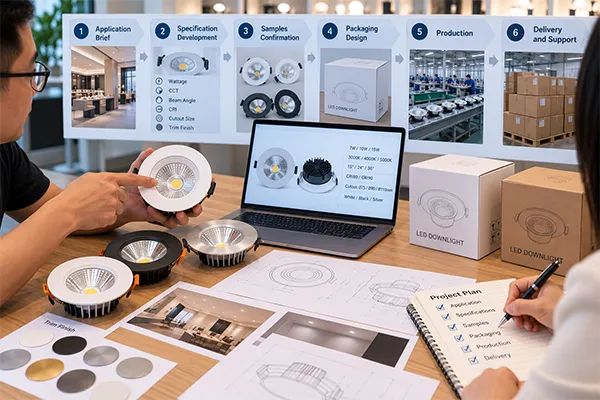
A lower-risk OEM LED downlight project starts with a clear application brief, moves through documented specifications and samples, and only then proceeds to production.11 Brands should review the product as a complete offer—including lighting performance, installation fit, finish, packaging, and supplier communication—not as an isolated unit price.
A Practical Development Process
We suggest the following sequence for buyers working with an OEM partner:
-
Define the commercial goal
Identify the target customer, channel, application, expected price level, and product range gap. -
Create an initial product brief
List preferred wattage, color temperature, beam angle, CRI, finish, cutout size, and packaging needs. Mark uncertain items clearly. -
Discuss available product platforms
Review which existing downlight designs can support the intended requirements without unnecessary complexity. -
Request samples with defined parameters
Make sure the sample configuration matches the intended production specification as closely as possible. -
Review samples in the intended context
Where possible, assess the downlight in a realistic ceiling and lighting environment. Compare appearance, beam spread, light color, installation fit, and packaging. -
Confirm documents and market requirements
Review available documentation and seek qualified local advice where application-specific or market-specific requirements apply. -
Approve written specifications and artwork
Record the final product parameters, packaging details, labels, carton marks, and sample approval status. -
Monitor production and pre-shipment details
Confirm lead time, inspection expectations, aging test arrangements, and shipping documentation.
Small Batches Can Support Better Decisions
For a new brand line, a small initial order can be useful when the commercial situation allows it. It can help a buyer test distributor feedback, customer response, packaging clarity, installation experience, and sales positioning before making a larger commitment.
Small-batch sourcing is not suitable for every product because unit cost, component availability, and custom finishes may be affected by volume.12 Still, a supplier that discusses these limits openly can help brands select a more realistic launch path.
In our own OEM discussions, we have found that customers value fast quotation feedback when they are still comparing product directions. However, speed should not replace clarification. A quick quotation is most helpful when it is based on a reasonably clear product brief.
Frequently Asked Questions
What is the difference between OEM and private-label LED downlights?
Private-label LED downlights usually focus on applying a buyer’s brand name, packaging, and labels to an existing product. OEM work can include private labeling, but it may also involve defining specifications such as wattage, color temperature, beam angle, CRI, trim finish, and packaging to fit a specific product strategy.
How do I choose between different OEM LED downlight manufacturers?
You should compare more than the quoted unit price. Review each supplier’s product questions, sample process, customization boundaries, quality-control explanation, documentation, response speed, production communication, and repeat-order support. A manufacturer that clarifies trade-offs may be a better long-term partner than one that promises every option immediately.
Which LED downlight specifications should a private-label brand define first?
Start with the intended application, target customer, price position, cutout size, wattage or output level, color temperature, beam angle, CRI, trim finish, and packaging requirements. You can then discuss which combinations are practical within available product platforms and expected order quantities.
Should I verify LED downlight certifications myself?
Yes. Buyers should verify that certification documents and declarations apply to the exact product configuration and destination market. Project requirements and local regulations can vary. We recommend that brands seek advice from qualified testing, compliance, or local market professionals when requirements are unclear.
Can a small first order be useful for an OEM LED downlight project?
A small first order can help a brand assess sales response, distributor feedback, packaging performance, and installation experience before scaling. However, buyers should discuss minimum order quantities, component availability, custom finishes, and pricing because some configurations may be less practical at low volumes.
Conclusion
Global brands choose OEM LED downlight manufacturers to build products that fit real applications, not simply to apply a logo to a standard box. The strongest projects begin with the target customer and installation environment, then move toward practical specifications, sample review, documented approvals, and supplier verification. At Upward Lighting, we support brands that want to turn product ideas into defined LED downlight programs with OEM and ODM options. Contact our team to discuss your application, target specifications, and private-label requirements.
"Determining the Effect of the Returns Management ...", https://trace.tennessee.edu/cgi/viewcontent.cgi?referer=&httpsredir=1&article=2592&context=utk_chanhonoproj. Studies of consumer satisfaction and expectation disconfirmation indicate that products perceived as inconsistent with expected performance or attributes are more likely to generate dissatisfaction and complaint behavior. Evidence role: general_support; source type: research. Supports: Research on expectation-disconfirmation and product returns or complaints when products do not meet customer expectations.. Scope note: Such evidence supports the general commercial mechanism; it does not quantify return rates for a particular downlight specification. ↩
"Color temperature", https://en.wikipedia.org/wiki/Color_temperature. Experimental studies in indoor lighting report that correlated color temperature can influence subjective impressions of ambience, including perceived warmth and visual atmosphere. Evidence role: mechanism; source type: paper. Supports: Experimental lighting research showing that correlated color temperature can affect occupants' subjective impressions of indoor ambience.. Scope note: Perceived atmosphere also depends on illuminance, room finishes, daylight, culture, and the specific task or setting. ↩
"3000K vs 4000K Lighting: Differences & Best Uses", https://www.salehdeco.com/blog/lighting-guide-2/3000k-vs-4000k-lighting-which-is-better-for-your-space-1?srsltid=AU7gw4X6vjEIPOC11brhb_KU3TXp-mlDN_hMVmN92wfpDNqh-1BB7-X8. Lighting-design guidance commonly associates lower correlated color temperatures around 3000 K with warm, hospitality-oriented interiors and neutral-white temperatures around 4000 K with many office and task-oriented settings. Evidence role: general_support; source type: education. Supports: Lighting-design guidance describing common, rather than mandatory, color-temperature choices for hospitality and office settings.. Scope note: These are design conventions rather than universal requirements; suitable color temperature depends on local practice, daylight, finishes, tasks, and user preference. ↩
"Glare", https://www.energy.gov/cmei/ssl/glare. Lighting-design guidance explains that a luminaire's beam spread determines the distribution of light on surrounding surfaces and can affect visual comfort when considered with luminaire luminance, aiming direction, and spacing. Evidence role: mechanism; source type: institution. Supports: Lighting guidance explaining that beam spread and luminaire distribution affect illuminance patterns and may contribute to glare or visual comfort conditions.. Scope note: Beam angle alone does not determine comfort or glare performance. ↩
"Color rendering index", https://en.wikipedia.org/wiki/Color_rendering_index. Color-rendering measures characterize how a light source alters the perceived colors of objects relative to a reference illuminant, which is relevant to the appearance of skin, materials, and displayed goods. Evidence role: definition; source type: institution. Supports: Authoritative color-science guidance defining color rendering and describing its relevance to the appearance of objects under a light source.. Scope note: CRI is a commonly used color-rendering metric, but it does not fully predict preference or the rendering of every color sample. ↩
"Evaluation of Daylight Perception Assessment Methods - PMC", https://pmc.ncbi.nlm.nih.gov/articles/PMC9035900/. Lighting-quality research finds that evaluations of appearance and visual comfort depend on contextual conditions such as room geometry, surface reflectance, daylight, task, and the surrounding luminaires. Evidence role: general_support; source type: paper. Supports: Research showing that assessments of lighting quality and appearance are influenced by the physical and visual context of use.. Scope note: This supports contextual sample evaluation generally and does not establish that every isolated sample review will miss a defect. ↩
"2024 Lighting Design Guidelines", https://www.codot.gov/safety/traffic-safety/assets/documents/cdot-lighting-design-guideline.pdf. Illuminance uniformity in an interior depends on the luminaire's photometric distribution together with mounting height, spacing, and room geometry; unsuitable combinations can produce visible bright and dark areas. Evidence role: mechanism; source type: institution. Supports: Lighting-design principles showing that luminaire photometry, mounting height, and spacing determine illuminance distribution and uniformity.. Scope note: A beam-spread specification alone is insufficient to predict room uniformity without a layout calculation or measurement. ↩
"Lighting Design Manual", https://www.cfm.va.gov/til/dManual/dmLighting.pdf. Electrical-installation guidance requires recessed luminaires to be installed according to manufacturer instructions, including the specified opening dimensions and applicable clearances, so incompatible ceiling cutouts can require alteration or prevent correct fitting. Evidence role: general_support; source type: government. Supports: Installation guidance indicating that recessed luminaires must be installed in openings and clearances consistent with the manufacturer's instructions.. Scope note: Exact requirements depend on the jurisdiction, luminaire design, ceiling construction, and applicable electrical code. ↩
"General Use Products: Certification and Testing", https://www.cpsc.gov/Business--Manufacturing/Testing-Certification/General-Use-Products-Certification-and-Testing. Professional lighting and compliance guidance distinguishes product selection from project-specific lighting design, code assessment, and verification, which may require qualified practitioners familiar with the installation jurisdiction. Evidence role: expert_consensus; source type: institution. Supports: Professional guidance distinguishing lighting design, code compliance, and product-supply functions.. Scope note: The precise division of responsibilities varies by contract, jurisdiction, project type, and applicable regulations. ↩
"EU WEEE_RoHS", https://www.trade.gov/eu-weeerohs. Official conformity-assessment guidance states that manufacturers must identify the legislation applicable to their product and prepare the required technical documentation and declarations before placing it on the relevant market. Evidence role: general_support; source type: government. Supports: Official conformity-assessment guidance showing that applicable requirements, technical documentation, and declarations depend on the product and market legislation.. Scope note: CE and RoHS obligations concern relevant regulated markets and do not by themselves establish compliance in every destination country or for every project specification. ↩
"The role of product development practices on new ... - PMC", https://pmc.ncbi.nlm.nih.gov/articles/PMC7893682/. Quality-management guidance for design and development emphasizes establishing documented requirements, conducting reviews and verification or validation activities, and controlling changes before product release. Evidence role: general_support; source type: institution. Supports: Quality-management and product-development principles requiring defined requirements, design review, verification, validation, and controlled changes before release.. Scope note: A staged approval process reduces avoidable uncertainty but cannot eliminate market, manufacturing, or supply-chain risk. ↩
"Economies of scale", https://en.wikipedia.org/wiki/Economies_of_scale. Manufacturing economics describes economies of scale: when setup, tooling, purchasing, and administrative costs are distributed across fewer units, low-volume production generally has higher unit costs and may face less favorable component procurement terms. Evidence role: mechanism; source type: education. Supports: Economic evidence that fixed production, setup, and procurement costs are spread over fewer units at lower volumes, increasing per-unit cost and affecting sourcing options.. Scope note: The magnitude of the effect varies by product architecture, supplier capacity, component availability, and the degree of customization. ↩