Heat dissipation in LED downlights is often overlooked when buyers focus on wattage, lumen output, and cutout size. However, a compact downlight with insufficient thermal capacity may face faster component ageing, light-output decline, and more maintenance risk1. The practical solution is to evaluate power, housing structure, heat-sink design, and the real installation environment together.
Heat dissipation in LED downlights matters because LED chips, drivers, and other components need a controlled path for releasing operating heat. Buyers should assess the full fixture design—not only whether the body uses aluminium—before selecting a wattage for a given cutout. The correct choice depends on the heat sink, fixture dimensions, driver layout, ceiling ventilation, insulation, and project conditions.
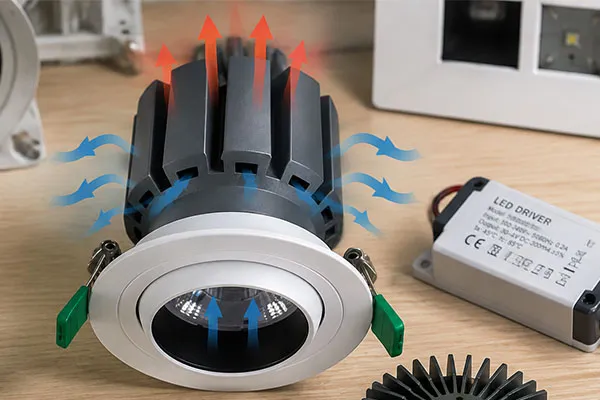
In our work as an LED lighting manufacturer in Zhongshan, we regularly discuss the same question with contractors and importers: “Can we get more watts from the same ceiling opening?” That question is reasonable, but it should lead to a broader review of the downlight’s thermal structure and installation conditions before the specification is finalized.
What Does Heat Dissipation in LED Downlights Actually Mean?
Heat dissipation in LED downlights can sound like a simple material issue. Buyers may see an aluminium body and assume the product will run reliably. Yet an aluminium label alone does not explain how heat moves away from the LED source, through the housing, and into the surrounding air.
Heat dissipation in LED downlights refers to the fixture’s ability to transfer operating heat away from heat-sensitive components through its complete thermal path.2 This path includes the LED board, thermal interface materials, heat sink, fixture body, driver arrangement, and available airflow around the installed product.
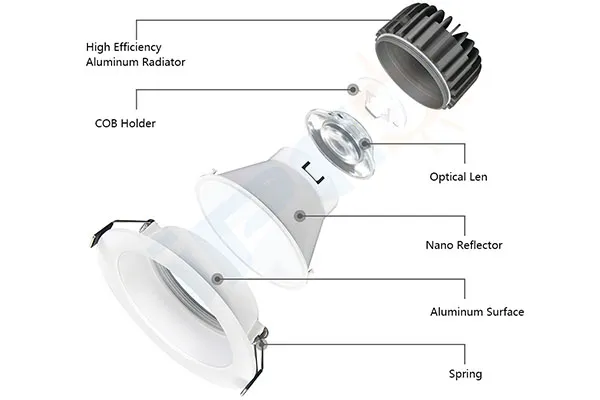
The Heat Path Is a Complete System
A downlight does not manage heat through one part alone. The heat generated during operation needs to move through several connected elements. If one part of the system is poorly designed, it may limit the performance of the overall structure.
Buyers should consider the following path:
-
LED chip and LED board
The LED source generates light, but it also generates heat during operation. The board and its connection to the housing influence how effectively that heat can move outward. -
Thermal interface materials
Thermal paste, pads, or other interface materials may help transfer heat between the LED board and the heat sink.3 The material type, application quality, and contact area should be evaluated as part of product quality control. -
Heat sink and fixture body
The heat sink provides surface area for releasing heat. Its thickness, fin arrangement, dimensions, contact design, and material composition all matter. -
Driver location and structure
A driver placed close to the light engine may create additional thermal pressure in a compact fixture.4 Some designs separate the driver, while others integrate it. Neither approach is automatically better; the overall design should be reviewed. -
Ceiling void and surrounding air
A well-designed fixture may still face a more demanding environment if the ceiling void is small, poorly ventilated, insulated, or exposed to surrounding heat sources.
In my experience, product discussions become much clearer when we stop asking, “Is the housing aluminium?” and start asking, “What is the full heat path from the LED board to the surrounding air?”
Why Material Claims Can Be Misleading
Aluminium is commonly used in LED downlight housings because it can support thermal management and manufacturing needs.5 Still, it is only one input. A thin aluminium body with limited surface area may not perform the same as a thicker or longer structure with a more developed heat sink.
At the same time, buyers should avoid the opposite shortcut. A heavier fixture, a larger visible heat sink, or a longer body does not automatically guarantee better thermal performance. The design must work as a complete system.
When reviewing a supplier’s LED downlight, I recommend asking for:
- Product body dimensions
- Cutout size and trim size
- Heat-sink structure or sectional drawings
- Main housing and heat-sink materials
- LED board arrangement
- Driver position and driver specification
- Rated power options for each body size
- Installation instructions and limitations
- Any available thermal or product test documentation
These details help project buyers compare products on more than appearance or price.
Can Higher Wattage Fit the Same LED Downlight Cutout?
A higher-wattage downlight in the same cutout can look attractive because it may simplify installation and provide more output without changing the ceiling layout. However, more power generally means more heat must be managed6. A fixed ceiling opening does not automatically mean every power level is equally suitable.
A higher-wattage LED downlight may fit the same cutout only when its thermal structure has been correspondingly designed or enlarged. Buyers should verify the body depth, heat-sink area, driver arrangement, and installation conditions instead of assuming that the visible opening determines thermal capacity.
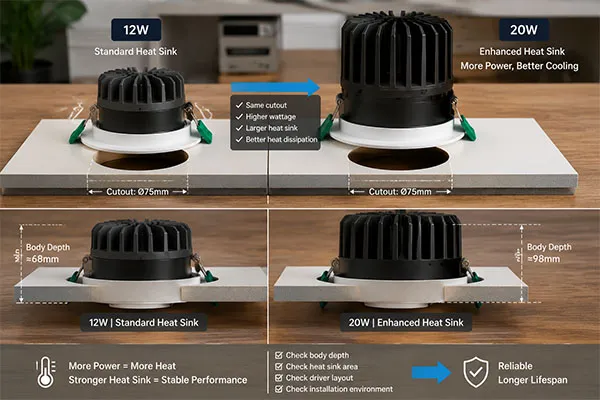
The Cutout Is Not the Whole Fixture
Many buyers begin with cutout size because it is critical for installation. For example, a renovation project may already have existing ceiling holes, and changing them can add labor, dust, delays, and cost. That makes a “higher wattage in the same cutout” option commercially appealing.
Still, the cutout only describes the ceiling opening. It does not reveal:
- The fixture’s total height
- The heat-sink thickness
- The available dissipation surface
- The internal spacing around the LED board
- The placement of the driver
- The airflow available above the ceiling
- The presence of insulation or other obstructions
A manufacturer may redesign a higher-power model with a longer body, thicker housing, more effective external fins, a separated driver, or a different internal layout. In that case, the same cutout may be possible because the fixture behind the ceiling has changed.
However, if the power increases while the body structure remains almost unchanged, buyers should ask the supplier to explain how the additional thermal load is managed.
A Practical Comparison for Procurement Teams
The table below shows the type of comparison that helps buyers evaluate products. It does not establish universal safe wattage levels. Each product and installation should be verified individually.
| Evaluation Point | Lower-Power Option | Higher-Power Option in Same Cutout | Buyer Question |
|---|---|---|---|
| Rated power | Lower thermal demand | Higher thermal demand | Has the thermal structure changed? |
| Fixture depth | May be compact | May need additional depth | Is there enough ceiling void space? |
| Heat-sink structure | May use simpler geometry | May need more area or redesigned fins | Can the supplier provide drawings or photos? |
| Driver layout | Integrated or external | May require different arrangement | Where is the driver located? |
| Ceiling condition | Standard void may be adequate | Installation may be more demanding | Is insulation or restricted airflow present? |
| Maintenance exposure | Lower project thermal pressure | May increase risk if poorly matched | What is the expected access difficulty after installation? |
I have seen project buyers compare two downlights with the same front diameter and assume they are equivalent. Once they compare the rear body, heat sink, and driver layout, the products can look very different. That is why the visible trim should not be the main basis for selecting power.
Which LED Downlight Design Features Should Buyers Evaluate?
Heat dissipation in LED downlights depends on several connected design choices. Buyers should not rely on a single claim such as “die-cast aluminium,” “heavy housing,” or “high-lumen design.” A more reliable procurement process compares the fixture’s structure, power, and installation requirements as one package.
Buyers should evaluate LED downlight heat dissipation by reviewing the complete fixture structure: effective heat-sink area, body dimensions, housing material, LED board contact, driver arrangement, rated power, and installation limitations. No single material or weight claim can confirm long-term thermal suitability.
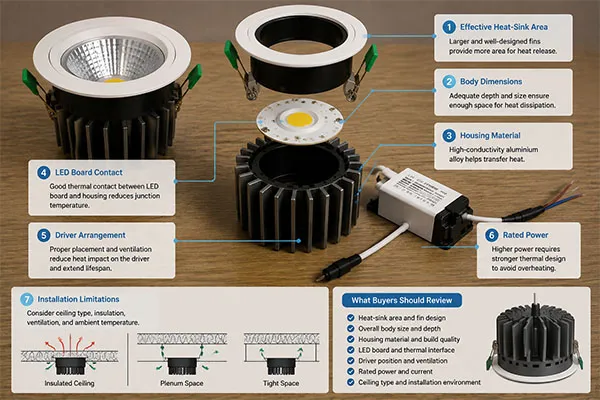
1. Effective Heat-Sink Area
A heat sink needs enough usable surface area to release heat. This is not always visible from the front of the fixture. Some downlights have external fins, while others use a more solid body or internal structure.
Buyers should ask whether the heat-sink design differs between wattage versions. If a supplier offers several power options under one product family, it is worth confirming whether each option uses:
- The same housing
- Different body heights
- Different heat-sink geometries
- Different LED board configurations
- Different driver specifications
A shared appearance does not necessarily mean a shared internal structure.
2. Housing Dimensions and Ceiling Clearance
The outer body dimensions affect both installation and heat management. A deeper body may provide more structural space, but buyers must confirm that it fits the ceiling void.
Contractors should review:
- Ceiling depth
- Clearance above the fixture
- Nearby pipes, ducts, cables, and framing
- Access for driver placement
- Distance from insulation materials
- Installation orientation where applicable
A product that performs suitably in an open demonstration environment may face different conditions in a crowded commercial ceiling.
3. LED Board and Driver Arrangement
The LED board and driver are key parts of the thermal system. The physical arrangement can influence how heat is distributed within a compact fitting.
For example, an integrated driver design may simplify installation and improve visual neatness. Yet buyers should still ask how the driver is positioned relative to the heat source. An external driver may provide more placement flexibility, but it also requires suitable space and proper installation.
Neither solution should be selected by assumption. The supplier should explain the intended installation method and any limitations.
4. Surface Finish and Product Construction
Surface treatments are often chosen for appearance, corrosion resistance, or project consistency. For outdoor lighting, surface treatment may be especially important. For indoor LED downlights, the finish is still part of the overall construction, although it should not be treated as standalone proof of thermal performance.
At our factory, we discuss customization options such as wattage, color temperature, beam angle, CRI, body size, and finish with OEM and ODM customers. When a customer requests a power increase, I believe the discussion should also include body structure and installation conditions. A wattage request is not only an electrical specification; it is a product-design decision.
How Do Installation Conditions Affect Heat Dissipation in LED Downlights?
Even a carefully designed fixture can face different operating conditions after installation. Ceiling void space, insulation, ventilation, ambient surroundings, and the proximity of other equipment may all affect heat dissipation in LED downlights. Buyers should include these conditions in the specification stage rather than treating them as an afterthought.
Installation conditions affect heat dissipation in LED downlights because the fixture needs suitable surrounding space and airflow to release operating heat7. Before selecting wattage, contractors should verify ceiling depth, ventilation, insulation, nearby heat sources, and the supplier’s installation guidance.
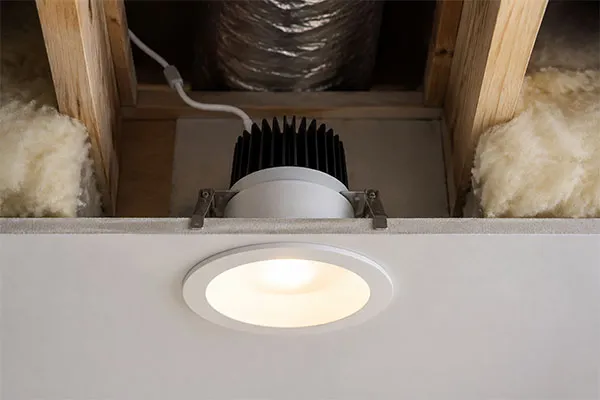
Ceiling Voids Are Real Project Environments
A downlight is often tested, displayed, or reviewed before it enters a finished ceiling. In the actual project, the environment can be very different.
A ceiling void may contain:
- Mineral wool or other insulation materials
- HVAC ducts and warm air paths
- Cable trays and electrical wiring
- Structural beams
- Limited air volume
- Other recessed fixtures operating nearby
- Fire-rated ceiling systems with specific installation requirements
These conditions do not automatically make a downlight unsuitable. They do mean that the buyer, contractor, and supplier should confirm compatibility before installation.
Questions Contractors Should Ask Before Ordering
Before finalizing an LED downlight schedule, I recommend a simple project-side review:
-
What is the required cutout size?
Confirm the existing or planned opening diameter. -
How much depth is available above the ceiling?
Compare the available void depth with the full fixture and driver dimensions. -
Will insulation contact or surround the fitting?
Ask the supplier for installation limitations. Do not assume every recessed fixture is intended for every insulated-ceiling arrangement.8 -
Is airflow restricted?
Small enclosed cavities may create more demanding operating conditions than open ceiling voids. -
Are other heat sources nearby?
HVAC equipment, electrical devices, and clusters of fixtures can affect the local environment. -
Does the project require specific documentation?
Fire, electrical, environmental, or market-access requirements should be reviewed against project specifications and applicable local rules.
Why This Matters for Lifecycle Cost
When thermal conditions are unsuitable, the possible consequence chain can extend beyond the fixture itself. Inadequate heat management may accelerate ageing of LEDs, drivers, and related components.9 It may also contribute to earlier light-output depreciation, more service calls, replacement work, and disruption in occupied spaces.
For a hotel corridor, retail store, office, or residential development, replacing recessed fixtures can involve more than the cost of a new product. The project may also face labor costs, ceiling access issues, customer complaints, and operational disruption.
That is why the lowest initial unit price is not always the lowest project cost.10 Buyers should compare product price with the risk of maintenance access and replacement frequency.
What Should Buyers Ask an LED Downlight Supplier?
Procurement teams often need a clear, repeatable method for evaluating suppliers. Heat dissipation in LED downlights should be part of the supplier conversation from the quotation stage, especially when the project requests higher power in a compact cutout or has restricted ceiling conditions.
Buyers should ask LED downlight suppliers for clear information about body dimensions, heat-sink structure, materials, rated power, driver configuration, installation limitations, and relevant product documents. A supplier should verify whether a selected size-power-installation combination is appropriate for the stated project conditions.
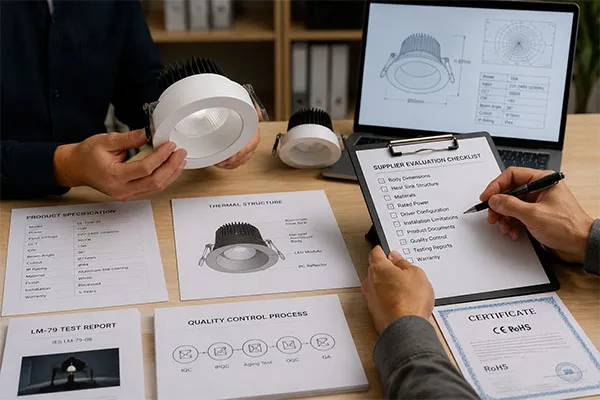
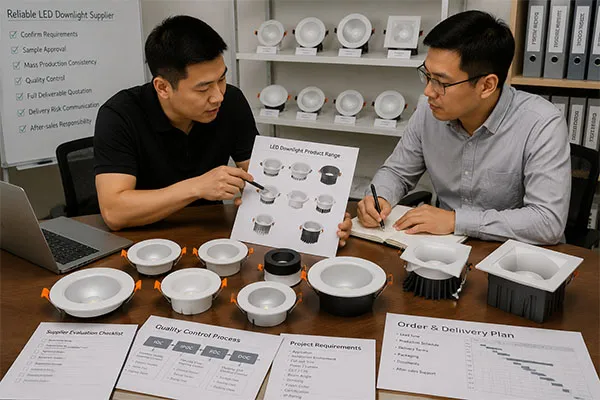
A Supplier Evaluation Checklist
Use the following checklist during quotation comparison and sample approval.
| Supplier Information | Why It Matters |
|---|---|
| Full product dimensions | Confirms ceiling void compatibility and body depth |
| Cutout size and trim diameter | Supports installation planning |
| Rated power and lumen specification | Establishes the requested performance level |
| Heat-sink material and structure | Helps evaluate the thermal design beyond a basic material claim |
| LED board and driver details | Supports comparison of component arrangement |
| Installation instructions | Identifies ceiling, ventilation, and insulation limitations |
| Product drawings or sectional images | Makes the rear structure easier to compare |
| Ageing-test process | Indicates an outgoing quality-control step |
| CE, RoHS, or other documents where required | Supports market and project document review; buyers should verify applicability and validity |
| Sample availability | Allows project-side review before bulk purchase |
How We Use Ageing Checks in Production
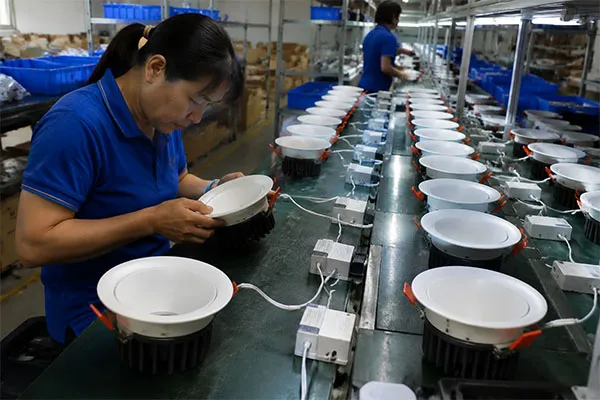
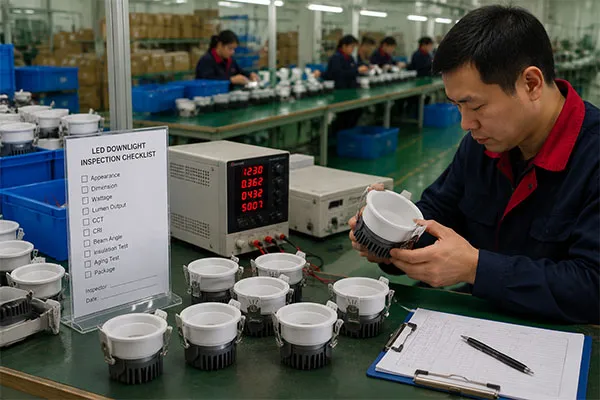
At our factory, we conduct 100% ageing checks before shipment, generally for 4 to 8 hours depending on the product and production arrangement. This outgoing quality-control step helps us identify obvious issues before products leave the factory.
However, buyers should understand the proper scope of this process. A 4–8-hour ageing check is not proof of complete long-term thermal reliability, lifetime performance, or compliance with every thermal standard.11 It is one part of quality control.
For application-specific decisions, buyers should also request relevant product documentation, review samples, and consult qualified professionals where the project environment is unusual or demanding.
Build Thermal Questions into the RFQ
An effective request for quotation can include more than wattage, color temperature, and quantity. It can state:
“Please confirm the product body dimensions, cutout size, heat-sink structure, driver arrangement, installation requirements, and suitability for the available ceiling void. The project requires [specified wattage] in [specified cutout], with [ventilation/insulation conditions if known].”
This wording encourages suppliers to respond with product-specific information instead of simply quoting the lowest-cost option.
For OEM and ODM projects, the conversation can go further. Buyers may request customized wattage, CCT, beam angle, CRI, body dimensions, and finishes. In these cases, the thermal structure should be reviewed whenever power or fixture size changes.
Frequently Asked Questions
Does an aluminium LED downlight always have good heat dissipation?
No. Aluminium can be a useful material in an LED downlight, but it does not guarantee effective heat dissipation by itself. Buyers should assess the complete thermal path, including heat-sink area, body dimensions, LED board contact, driver arrangement, rated power, and installation environment.
Can I choose a higher-wattage downlight with the same cutout size?
You may be able to, but the product should be evaluated carefully. A higher-power option may require a deeper body, a redesigned heat sink, or a different driver arrangement. Ask the supplier to verify the fixture structure and installation suitability for your project.
Does a larger heat sink guarantee better LED downlight performance?
No. A larger heat sink may provide more potential dissipation area, but it is not a complete guarantee. The full design matters, including material quality, fin geometry, thermal contact, fixture layout, power level, and airflow around the installed downlight.
Do 4–8-hour ageing tests prove LED downlight lifetime?
No. Ageing tests are useful outgoing quality-control checks that may help identify immediate issues before shipment. They should not be presented as proof of long-term lifetime, complete thermal reliability, or compliance with all project-specific standards. Buyers should review relevant documents and samples.
What installation details should I provide to an LED downlight supplier?
Provide the cutout size, available ceiling depth, ceiling material, ventilation conditions, insulation presence, nearby equipment, required wattage, and application type. This information helps the supplier assess whether the selected LED downlight structure is suitable for the stated installation conditions.
Conclusion
Heat dissipation in LED downlights is not a simple question of aluminium housing or visible fixture size. It is a selection decision based on the relationship between cutout size, rated power, heat-sink structure, body dimensions, driver arrangement, and the actual ceiling environment. Buyers should avoid assuming that more watts in the same opening always means an equivalent product. If you are sourcing LED downlights for a project, contact us with your cutout, wattage, and installation requirements, and we can help review a suitable OEM, ODM, or standard product option.
"Lumen Maintenance Testing of the Philips 60-Watt ...", https://www.energy.gov/sites/prod/files/2018/06/f52/LPrize_60W-LumenMaintTesting_2016.pdf. Thermal-management research indicates that elevated junction and component temperatures can accelerate LED lumen depreciation and reduce the reliability of associated electronic components, although the magnitude of the effect depends on the specific LED package, driver, operating current, and ambient conditions. Evidence role: mechanism; source type: research. Supports: Elevated LED junction and component temperatures can reduce luminous efficacy, accelerate lumen depreciation, and shorten the useful life of LED lighting components.. Scope note: The evidence supports the general thermal-reliability mechanism but does not establish the performance of any particular downlight model. ↩
"DOE Solid-State Lighting CALiPER Program 2009 Roundtable", https://www1.eere.energy.gov/buildings/publications/pdfs/ssl/2009_caliper_roundtableproceedings.pdf. Technical guidance on LED thermal management describes heat removal as a thermal path from the LED junction through intervening materials and heat-spreading structures to ambient air; thermal resistance along that path governs operating temperature. Evidence role: definition; source type: government. Supports: LED thermal management requires a heat-transfer path from the LED junction through package and luminaire materials to the surrounding environment.. ↩
"In Perspective of Xilinx Virtex-5QV Thermal Management", https://ntrs.nasa.gov/api/citations/20160001771/downloads/20160001771.pdf. Studies of thermal interfaces show that compliant greases, pads, and related materials can reduce contact thermal resistance by filling surface asperities and displacing insulating air gaps between a heat source and a heat sink. Evidence role: mechanism; source type: paper. Supports: Thermal interface materials can reduce interfacial thermal resistance by filling microscopic gaps between contacting surfaces.. Scope note: Actual benefit depends on material conductivity, bond-line thickness, pressure, coverage, ageing, and the quality of the mating surfaces. ↩
"Solid State Lighting LED Product Development and ...", https://www.energy.gov/documents/ledrtprdctmfg-reportoct2016pdf. Research on LED-driver reliability reports that elevated operating temperature can shorten the life of temperature-sensitive electronic components, making driver thermal placement and local ambient temperature relevant design considerations. Evidence role: mechanism; source type: paper. Supports: Elevated temperatures can reduce the lifetime of temperature-sensitive components in LED drivers, particularly capacitors and semiconductor devices.. Scope note: Proximity alone does not prove excessive driver temperature; the outcome depends on driver design, insulation, heat paths, load, and ventilation. ↩
"Heat sink", https://en.wikipedia.org/wiki/Heat_sink. Materials references identify aluminium as a comparatively thermally conductive, lightweight, and readily formable metal, properties that support its common use in heat-transfer components such as heat sinks and luminaire housings. Evidence role: general_support; source type: government. Supports: Aluminium has relatively high thermal conductivity among commonly used structural metals and is widely used for heat-transfer and heat-sink applications.. Scope note: Material properties alone do not demonstrate that a specific aluminium housing provides adequate thermal performance. ↩
"Investigation of the Long-Term Aging Characteristics of ...", https://www.energy.gov/sites/default/files/2021-10/ssl-rti-cob-benchmark-sept2021.pdf. LED thermal analyses treat the non-radiant portion of electrical input power as heat generated within the device, so higher input power generally increases thermal load unless efficiency and operating conditions change materially. Evidence role: mechanism; source type: research. Supports: The portion of LED electrical input not emitted as optical radiation is converted to heat that must be conducted or convected away.. Scope note: Heat generation is not determined by wattage alone because optical efficiency, driver losses, and operating conditions also affect the total thermal load. ↩
"Impact of Thermal Dissipation on the Lighting Performance ...", https://pmc.ncbi.nlm.nih.gov/articles/PMC8776062/. Heat-transfer principles show that natural-convection cooling depends on exposed surface area, temperature difference, and air movement; enclosure or airflow restrictions can therefore increase the operating temperature of a recessed luminaire. Evidence role: mechanism; source type: education. Supports: Restricted natural convection and confined air volumes can increase the temperature of heat-generating equipment by limiting heat transfer to ambient air.. Scope note: The resulting temperature rise must be determined for the particular fixture, enclosure geometry, insulation arrangement, and ambient temperature. ↩
"Insulating and Air Sealing Existing Non-ICAT Recessed Lights", https://basc.pnnl.gov/resource-guides/insulating-and-air-sealing-existing-non-icat-recessed-lights. Energy-efficiency and electrical-safety guidance distinguishes recessed luminaires rated for insulation contact from fixtures requiring clearance, indicating that insulation compatibility must be verified against the specific product rating and installation instructions. Evidence role: general_support; source type: government. Supports: Recessed luminaires may have specific insulation-contact ratings and clearance requirements, and installation must follow the product listing and instructions.. Scope note: Ratings, terminology, and legal requirements vary by market and electrical code; local rules and the fixture's certified instructions remain controlling. ↩
"Workshop on Quantitative Tools for Condition Assessment ...", https://www.nist.gov/document/10-09-29-workshop-proceedings-rev26pdf. Reviews of solid-state-lighting reliability identify elevated temperature as a major stress factor affecting LED-package materials and driver electronics, with degradation rates influenced by component design and operating conditions. Evidence role: expert_consensus; source type: research. Supports: Temperature is a recognized reliability stressor for LED packages, phosphors, solder joints, optical materials, and driver electronics.. Scope note: Accelerated-ageing findings provide reliability context and cannot by themselves predict the service life of an individual installed product. ↩
"Life-Cycle Cost Analysis for Buildings Is Easier Than You ...", https://www.fs.usda.gov/t-d/pubs/htmlpubs/htm08732839/page01.htm. Life-cycle-cost guidance evaluates an asset using costs incurred over its service life—including purchase, operation, maintenance, repair, and replacement—rather than relying solely on initial procurement price. Evidence role: general_support; source type: government. Supports: Life-cycle cost assessment includes acquisition costs together with operating, maintenance, repair, replacement, and disposal costs over an asset's service life.. Scope note: A life-cycle-cost framework does not establish that any specific downlight will have lower total cost without project-specific assumptions about energy use, labor, failures, and access. ↩
"Luminous Flux and Chromaticity Maintenance for Select ...", https://www.energy.gov/documents/sslrtilm80-color-ledsjuly2018pdf. Recognized LED lumen-maintenance methods use measured performance data collected under defined operating conditions and may use prescribed extrapolation procedures; a short production burn-in therefore cannot by itself substantiate long-term lifetime or thermal-reliability claims. Evidence role: general_support; source type: institution. Supports: Long-term LED lumen-maintenance and lifetime projections rely on specified measurement methods, extended test data, and controlled temperature and drive-current conditions.. Scope note: Lumen-maintenance methods principally address LED light-output behavior and do not alone demonstrate complete luminaire, driver, installation, or regulatory compliance. ↩