

A new LED downlight does not turn on. The project slows down. Everyone starts guessing, and one small mismatch can become a costly delay.
I treat a new LED downlight that does not work as a project diagnosis issue first. I check product failure, site voltage, driver type, dimming system, wiring, and specification match before I call it a bad lamp.
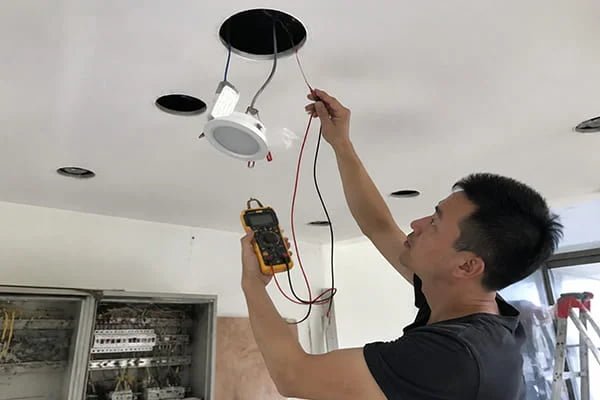
I have handled many after-sales questions from importers, contractors, and lighting brands, and I have learned one thing very clearly: a non-working new lamp is not always a lamp defect. Sometimes it is a real product issue. Sometimes it is a voltage mismatch. Sometimes it is a driver or dimmer problem. Sometimes the order information was incomplete from the start. If I want to solve the case fast, I need to separate these causes one by one, and that is where the real answer starts.
What Should I Check First When A New LED Downlight Does Not Work?
A new downlight fails on site. The buyer feels pressure. The installer needs an answer fast, but guessing often creates more mistakes.
I first compare the site input voltage, lamp label, driver label, wiring, dimming type, and control system. I also cross-test the lamp with another driver or another lamp when possible.
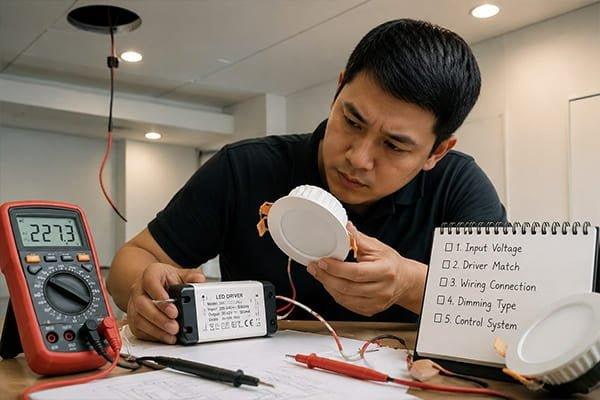
The first step is not to argue about who is responsible. The first step is to separate product failure from system mismatch. I usually ask the customer for clear photos of the lamp label, driver label, wiring connection, and installation environment. I also ask for a short video that shows the power test. This helps me see facts, not opinions.
I use a simple check path when I review a new LED downlight failure.
| Check item | What I want to confirm | Why it matters |
|---|---|---|
| Site voltage | 110V, 120V, 220V, 230V, 240V, or other | A wrong voltage can stop the lamp or damage the driver1 |
| Driver input | AC input range on the driver label | The driver must match the real site supply2 |
| Lamp and driver match | Constant current, wattage, output voltage range | A wrong driver may not light the LED module3 |
| Wiring | Live, neutral, earth, loop, connector type | Wrong wiring can stop the circuit |
| Dimming | Triac, 0-10V, DALI, non-dim, smart control | A dimmer mismatch can cause no light or flicker4 |
| Cross-test | Test another lamp or another driver | This helps locate the failed part |
I speak here as a manufacturer and supplier. I am not replacing the role of a local electrician or a code authority. But from factory and after-sales experience, this simple list often finds the cause faster than blaming the lamp first.
Can Factory Testing Prove The LED Downlight Is Not The Problem?
A supplier says the lamp passed testing. The site says the lamp does not work. Both sides feel confused, and the project loses time.
Factory aging tests reduce product-quality risk5, but they do not prove the lamp will work with every site voltage, dimmer, smart switch, sensor, or wiring condition6.
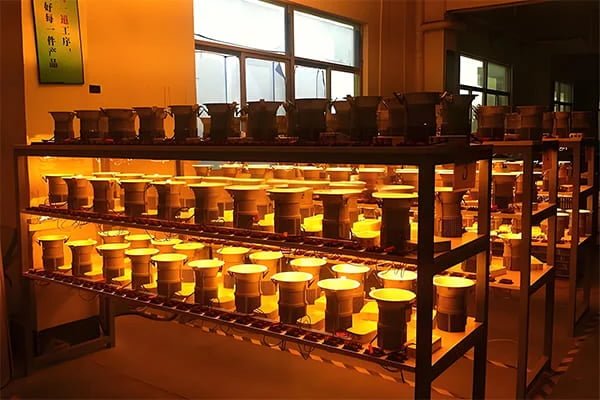
In my factory, we do 100% aging tests before shipment. Our LED downlights usually go through 4 to 8 hours of aging tests. I use this process to check basic function, light stability, and early quality problems before the goods leave our warehouse. This is important for OEM and ODM orders, because one batch may go into a hotel, apartment, shop, or public building project.
But I never tell a buyer that testing means nothing can fail on site. That would not be honest. Factory testing confirms that the product works under the tested condition. It does not confirm every real site condition in every country.
| Factory test can reduce | Factory test cannot fully control |
|---|---|
| Dead-on-arrival product risk | Wrong site voltage |
| Weak soldering or early failure risk | Wrong dimmer type |
| Basic driver function risk | Smart switch compatibility |
| Batch consistency risk | Poor site wiring condition |
| Light output abnormality risk | Incorrect order specification |
CE and RoHS also matter. They help confirm safety, environmental, and compliance direction for many markets.7 But they are not a magic guarantee. A CE and RoHS downlight can still fail to work if the buyer orders the wrong driver, the site uses the wrong voltage, or the control system does not match.8
This is why I always separate quality risk and application risk. Quality risk belongs mainly to the product and factory process. Application risk belongs to the match between the product and the project. A good B2B order needs both parts under control.
Why Can Voltage Assumptions Create A Complete Project Failure?
A project buyer assumes the country voltage is enough. The goods arrive. The downlights do not work, and the mistake becomes expensive.
I do not rely only on country-level voltage assumptions. I confirm the actual project site voltage before production, because one project can be different from the normal market expectation.9
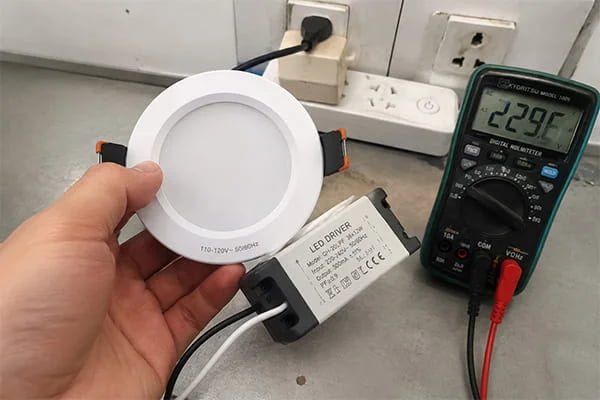
I once handled an anonymous project case that taught me this lesson again. The project was in the United States. The common assumption was that the downlights should be made for 110V. The order information followed that assumption. But the actual site required 220V. The lamps were made for the wrong voltage, so they did not work as expected on site.
This was not a simple “bad lamp” case. The product was produced according to the confirmed order specification. The site requirement was different from the assumed requirement. The result was still a real problem for the customer, because the project needed working lamps, not explanations.
I now ask more direct questions before production.
| Question I ask | Reason I ask it |
|---|---|
| What is the real site input voltage? | The country average is not enough |
| Is this a residential, commercial, or special project? | Some sites use different power systems |
| Will the downlight use a separate driver? | Driver choice depends on input and output |
| Does the project need dimming? | Dimming drivers must be confirmed early |
| Can the customer test samples first? | A sample test can prevent batch mistakes |
Voltage mistakes are painful because they are easy to prevent but hard to fix after shipment. For small trial orders, the loss may be controlled. For large project orders, the loss can include delay, replacement, labor, and trust. This is why I prefer slow confirmation before production rather than fast regret after delivery.
How Do Dimmers, Smart Switches, Sensors, And Drivers Affect LED Downlights?
The lamp works in the factory. It fails on the project. The hidden cause may be the control system, not the LED downlight itself.
I check whether the LED downlight is non-dimmable, triac dimmable, 0-10V, DALI, sensor-controlled, or smart-switch controlled before I judge the failure.
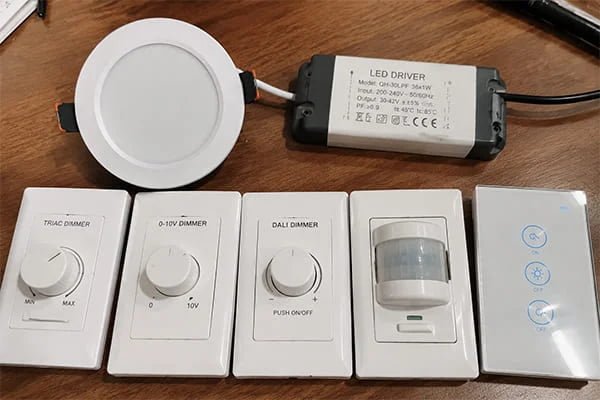
Many B2B buyers focus on wattage, color temperature, cut-out size, and price. These items matter. But driver and control compatibility often decide whether the lamp works smoothly on site. A non-dimmable driver may not work well with a dimmer.10 A triac dimmable driver may not work with a 0-10V control system.11 A smart switch may need a minimum load.12 A sensor may have special wiring requirements.
I do not like to guess in these cases. I ask for the control brand, control type, wiring diagram, and project drawing when the order is not standard.
| Control condition | Possible result if mismatched |
|---|---|
| Non-dim lamp with dimmer | No light, flicker, or unstable light |
| Triac driver with 0-10V control | Control failure or no dimming |
| Wrong constant-current driver | LED module may not light correctly |
| Sensor wiring not matched | Lamp may stay off or behave strangely |
| Smart switch load issue | Lamp may flash or fail to turn on |
The driver is not just an accessory. It is the bridge between the building power and the LED module. If this bridge does not match the project, the lamp may look like it has failed even when the LED part is normal.
For OEM and ODM orders, I treat the driver as a key specification. I confirm input voltage, output current, output voltage range, power factor, dimming mode, and certification needs. I also ask whether the buyer needs a branded driver or a cost-effective standard driver. A clear driver decision can save many after-sales emails later.
What Should I Confirm Before Placing A B2B LED Downlight Order?
A buyer wants a fast quotation. The supplier wants to ship fast. But missing details before ordering can create bigger delays later.
I use a pre-order checklist for LED downlights: site voltage, driver specification, dimming system, wiring needs, sample testing, certification needs, and responsibility boundaries.
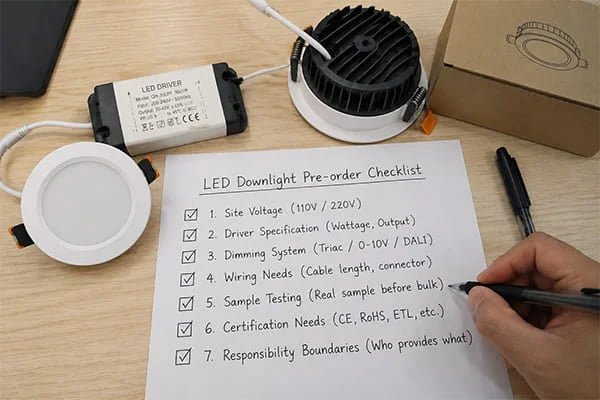
In B2B lighting projects, speed matters. I understand this because many customers ask for quick quotations, quick samples, and quick delivery. But I have also seen that unclear specifications cost more time than careful confirmation. A buyer may save one day before ordering and lose two weeks after installation.
I prefer to confirm the order in writing. This protects both sides. It also gives the project team a clear record when several people are involved, such as the importer, contractor, electrician, wholesaler, and final project owner.
| Pre-order item | What I confirm with the buyer |
|---|---|
| Site voltage | Actual project voltage, not only country name |
| Power | Required wattage and allowed tolerance |
| Color temperature | 2700K, 3000K, 4000K, 5000K, 6000K, or custom |
| Beam angle | Narrow, medium, wide, or project-specific lens |
| CRI | Standard CRI or high CRI requirement |
| Cut-out size | Ceiling hole size and fitting size |
| Driver type | Isolated, non-isolated, dimmable, non-dimmable |
| Control system | Triac, 0-10V, DALI, sensor, smart switch, or none |
| Surface finish | White, black, silver, gold, or custom color |
| Certification | CE, RoHS, or other market requirement |
| Sample test | Whether a sample must be tested on the real system |
| Responsibility boundary | What is covered by product warranty and what needs site checking |
I also suggest a sample test when the project has a special dimmer, sensor, smart control, or unusual voltage. A sample test is not only for checking the look. It is also for checking electrical match, installation fit, light effect, and user expectation.
This checklist does not remove every risk. No checklist can do that. But it lowers the chance of a simple mismatch becoming a full project problem. It also helps the buyer compare suppliers more fairly, because the quotation is based on the same real specification.
How Should I Communicate With The Supplier When The New Downlight Fails?
The site team is waiting. The supplier asks questions. The buyer feels frustrated, but incomplete information makes the case slower.
I send the supplier labels, photos, videos, wiring details, site voltage, control system information, and cross-test results so the cause can be found faster.
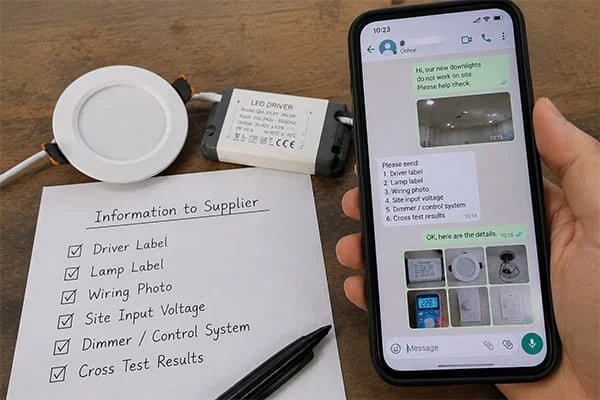
When a customer tells me, “The new downlight does not work,” I do not have enough information yet. I need to know what “does not work” means. Does it not turn on at all? Does it flash? Does it turn on for one second and shut off? Does only one piece fail, or does the whole batch fail? Does the same lamp work in another place?
The fastest cases usually have clear evidence.
| Information to send | Why it helps |
|---|---|
| Lamp label photo | Confirms model, wattage, and rating |
| Driver label photo | Confirms input and output specification |
| Site voltage reading | Confirms actual power supply |
| Wiring photo | Shows connection and possible mismatch |
| Control system photo | Shows dimmer, sensor, or smart switch type |
| Failure video | Shows real behavior |
| Cross-test result | Separates lamp issue from driver or site issue |
| Quantity affected | Shows whether it is one piece or batch issue |
I try to respond quickly because project time is valuable. A supplier should not hide behind long excuses. At the same time, a buyer should not send only one sentence and expect a perfect answer. Clear communication is part of project risk control.
If the evidence points to product failure, the supplier should handle it according to the agreed warranty and quality terms. If the evidence points to site mismatch, both sides should discuss the fastest practical solution. The goal is not to win an argument. The goal is to make the project move again with the least loss.
Conclusion
A new LED downlight may fail from product, voltage, driver, control, wiring, or order mismatch. I reduce risk by confirming specifications before production.
"The LED driver is written to output 90~96v, but the measurement ...", https://www.facebook.com/groups/ElectronicParts/posts/2536751756514144/. A technical reference on LED driver ratings explains that drivers are designed for specified input-voltage ranges and that operation outside those ranges can prevent normal output or overstress components; this supports the voltage-mismatch mechanism, although it does not diagnose any particular installation. Evidence role: mechanism; source type: education. Supports: LED drivers are designed for specified input voltage ranges, and operation outside those ratings can prevent proper output or overstress driver components.. Scope note: Contextual support only; the source would explain the mechanism, not prove that voltage mismatch caused the failure in the article's scenario. ↩
"How to read an LED driver label - Regency Insights Blog", https://insights.regencysupply.com/how-to-read-led-driver-label. Government or university guidance on LED driver selection describes the driver input rating as a required match to the available supply voltage, supporting the need to verify the actual site supply before installation. Evidence role: mechanism; source type: government. Supports: LED drivers require an input supply within their rated voltage and frequency range to operate correctly.. ↩
"LED Drivers: Constant Current vs. Constant Voltage - LEDSupply Blog", https://www.ledsupply.com/blog/constant-current-led-drivers-vs-constant-voltage-led-drivers/?srsltid=AfmBOor4zE3GEkz1tAXM3_FJaGxUenBSy1cd80IdCcPUhClKiUcNaWYT. A university or technical lighting reference on constant-current LED drivers explains that the driver's output current and voltage compliance range must match the LED load, supporting the claim that an unsuitable driver may fail to light the module. Evidence role: mechanism; source type: education. Supports: LED modules require drivers with compatible output current and voltage ranges; mismatched drivers may fail to power the LED load correctly.. ↩
"[PDF] LED Dimming: What you need to know - eere.energy.gov", https://www1.eere.energy.gov/buildings/publications/pdfs/ssl/dimming_webcast_12-10-2012.pdf. Research and standards-oriented lighting literature describes LED dimming as dependent on driver-control compatibility and reports that incompatibility may cause flicker, instability, or failure to illuminate; this supports the troubleshooting link, although outcomes vary by product and control design. Evidence role: mechanism; source type: research. Supports: LED dimming performance depends on compatibility between the LED driver and dimming control, and incompatibility can cause flicker, unstable output, or failure to operate.. Scope note: Contextual support; the source would establish known compatibility effects, not verify a specific dimmer-downlight pair. ↩
"[PDF] Alternative Test Methods for Electronic Parts - NASA NEPP", https://nepp.nasa.gov/DocUploads/C95C5348-122E-443B-99E2BCA6A9E31BAC/Alternative-Tests-Overview.pdf. Reliability-engineering literature describes burn-in testing as a method for detecting early-life electronic failures before field use, supporting the claim that factory aging tests can reduce product-quality risk. Evidence role: mechanism; source type: paper. Supports: Burn-in or aging tests are used in electronics reliability programs to screen for early-life failures and reduce infant-mortality risk.. ↩
"[PDF] TEST REPORT IEC 60601-1 - Medical Electrical Equipment Part 1", https://www.advancedenergy.com/getmedia/40d608e1-4f83-49d0-ad8b-545b7e26842c/en-certification-IEC60601-1-04-25.pdf. Testing and certification guidance for electrical equipment explains that evaluations are conducted under defined conditions and ratings, supporting the caution that factory testing does not prove operation with every voltage, control device, sensor, or wiring condition. Evidence role: general_support; source type: institution. Supports: Electrical product testing and certification are performed under defined test conditions and do not automatically demonstrate compatibility with all possible installation environments.. Scope note: Contextual support; such a source would support the general limitation of test conditions rather than address the author's specific factory process. ↩
"CE marking - Wikipedia", https://en.wikipedia.org/wiki/CE_marking. European Union guidance defines CE marking as a declaration of conformity with applicable EU requirements and the RoHS Directive as a restriction on specified hazardous substances in electrical and electronic equipment, supporting the article's description of their compliance and environmental relevance. Evidence role: definition; source type: government. Supports: CE marking indicates a manufacturer's declaration of conformity with applicable EU requirements, and RoHS restricts specified hazardous substances in electrical and electronic equipment.. ↩
"CE marking – obtaining the certificate, EU requirements - Your Europe", https://europa.eu/youreurope/business/product-requirements/labels-markings/ce-marking/index_en.htm. Official EU materials describe CE marking as a conformity declaration and RoHS as a hazardous-substance restriction regime, supporting the distinction between regulatory compliance and functional compatibility with unspecified drivers, voltages, or controls; the source does not directly test downlight performance. Evidence role: definition; source type: government. Supports: CE and RoHS address regulatory conformity and restricted substances rather than proving compatibility with all installation conditions.. Scope note: Contextual support; official CE and RoHS definitions clarify scope but do not evaluate any particular downlight. ↩
"Is USA residential 240v considered 120 or 180 degree phase?", https://www.reddit.com/r/AskElectricians/comments/1ajd4os/is_usa_residential_240v_considered_120_or_180/. References on mains electricity and U.S. electrical service describe multiple supply configurations, such as 120/240 V split-phase and higher-voltage commercial systems, supporting the point that a project's actual voltage may differ from a simplified country-level expectation. Evidence role: historical_context; source type: encyclopedia. Supports: Mains voltage can vary by country, building type, and electrical service configuration, so country-level assumptions may be incomplete.. Scope note: Contextual support; such sources establish voltage variability but do not verify the anonymous project case. ↩
"LED Driver and Dimmer Compatibility Guide - Enoled", https://enoled.com/learning-center/led-driver-and-dimmer/. Lighting research literature on LED dimming notes that dimming performance depends on a driver designed for the relevant control method, supporting the warning that a non-dimmable driver may operate poorly or fail when used with a dimmer. Evidence role: mechanism; source type: research. Supports: LED dimming requires a driver designed for the relevant dimming method; non-dimmable drivers may not respond correctly to dimmer-controlled input.. ↩
"LED Dimming Protocols: 0-10V vs DALI vs Phase-Cut Guide", https://www.jarvislighting.com/blogs/jarvis-lighting-insights/led-dimming-protocols-0-10v-dali-guide?srsltid=AfmBOopYWVgyANWbialZdLzug-CrXcJEaPkZqC5c8n0zsoJ-G_9B0JrW. A neutral lighting reference distinguishing phase-cut dimming from 0-10 V control would support the claim that a triac-dimmable driver is not necessarily compatible with a 0-10 V control system; the source provides protocol context rather than testing a specific product. Evidence role: definition; source type: research. Supports: Phase-cut or triac dimming and 0-10V dimming use different control architectures, requiring compatible drivers and controls.. Scope note: Contextual support; compatibility can depend on individual driver and controller specifications. ↩
"[PDF] LED Lighting Technical Guide - iautomatica.ru", https://s3.iautomatica.ru/uf/047/%D0%9A%D0%B0%D1%82%D0%B0%D0%BB%D0%BE%D0%B3%20LED%20Lighting.pdf. Technical guidance on electronic lighting controls notes that some controls have minimum-load or wiring requirements when used with low-wattage LED loads, supporting the statement that a smart switch may need a minimum load; the requirement is device-specific and must be confirmed from the control specification. Evidence role: mechanism; source type: institution. Supports: Certain electronic lighting controls may require a minimum load or neutral connection to function reliably with low-wattage LED loads.. Scope note: Contextual support; not all smart switches have the same minimum-load requirements. ↩