LED downlights are replacing traditional lighting because buyers increasingly need more predictable lifetime cost, more flexible specifications, and fewer maintenance disruptions. A low fixture price can look attractive at the start, but frequent relamping, difficult access, inconsistent light quality, and uncertain replacement availability can create larger costs over time. We help buyers assess the full picture.
Traditional lighting is being replaced by LED downlights because a properly specified LED fixture can reduce energy demand, relamping frequency, maintenance labor, and replacement risk over its working life1. However, buyers should not treat every LED downlight as interchangeable. They should verify light output, beam distribution, color quality, installation compatibility, driver design, certifications, and supplier consistency before making a retrofit or product-line decision.
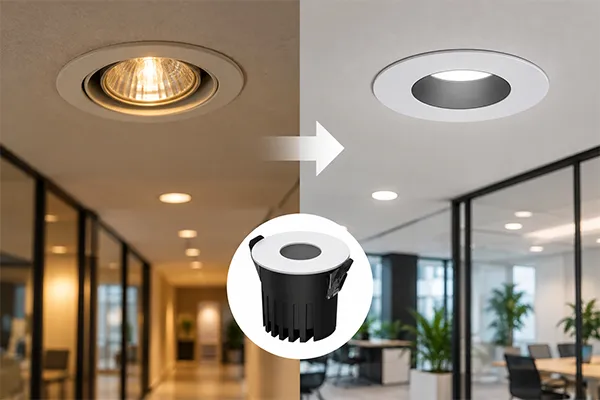
In repeated customer inquiries, quotations, and customization discussions, we often see buyers focus first on wattage or unit price. Those factors matter, but they rarely tell the full procurement story. A better decision starts with the lighting task, the existing installation, the maintenance environment, and the supplier’s ability to provide consistent products over time.
Why Are LED Downlights Changing the Lifetime Cost Calculation?
Traditional fixtures can appear inexpensive at purchase, especially when an existing project already uses familiar lamp holders, housings, and replacement lamps. The problem is that the apparent saving may disappear when maintenance teams must repeatedly access ceilings, replace lamps, manage stock, and respond to lighting failures.
LED downlights change the cost calculation by shifting attention from initial fixture price to total lifecycle cost2. Buyers should compare energy use, replacement frequency, maintenance labor, access difficulty, downtime, and the expected availability of replacement products. The best option depends on the specific site, operating schedule, and installation conditions—not simply on the lowest wattage.
Looking Beyond the Fixture Purchase Price
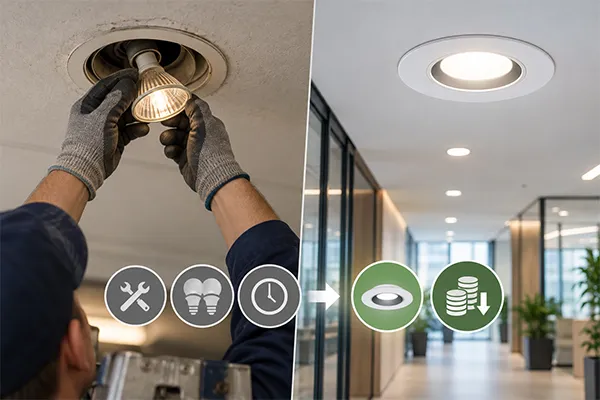
We encourage purchasing teams to separate purchase cost from cost of ownership. A traditional lighting system may use lower-cost lamps, but it can require more frequent intervention. This issue becomes especially important in commercial corridors, hotel lobbies, retail stores, offices, public areas, and high-ceiling spaces where every maintenance visit has a labor cost.
A lifecycle review should include the following factors:
- Electricity consumption: Compare actual operating watts, not only nominal lamp ratings.
- Operating hours: A fixture used 3 hours per day creates a different cost profile from one operating 12 or 18 hours per day.
- Relamping labor: Labor may cost more than the replacement lamp, particularly in overseas projects.
- Access equipment: Lifts, scaffolding, ceiling access, and safety procedures can significantly increase maintenance expense.
- Business disruption: Failed lighting can affect store presentation, guest experience, safety perception, or tenant satisfaction.
- Replacement inventory: Buyers may need to hold spare lamps, drivers, trims, or complete fixtures.
- Product continuity: A replacement plan is easier when a supplier can maintain stable specifications for future orders.
| Cost factor | Traditional lighting consideration | LED downlight consideration |
|---|---|---|
| Initial purchase price | Often lower for basic lamps or fixtures | Can vary based on driver, housing, optics, and specification |
| Energy use | Depends on lamp technology and control system | Often lower for a comparable lighting task, subject to proper selection |
| Maintenance frequency | May require more frequent lamp replacement | Can reduce interventions when quality and thermal conditions are suitable |
| Replacement work | Often involves recurring relamping | May involve driver or complete-fixture replacement, depending on design |
| Procurement planning | Common lamp formats may be familiar | Requires specification control and supplier consistency |
Maintenance Risk Is Often the Real Trigger
In our experience, many buyers begin a project by asking, “What wattage can replace this old lamp?” Later, they discover that the more urgent question is, “How often will our team need to return to this ceiling?”
That is why LED downlights are attractive for locations where access is difficult. A shopping center may have decorative ceilings. A hotel may need to avoid disturbing guests. An office may only allow maintenance outside business hours. In these situations, reducing service visits can be more valuable than achieving the lowest possible fixture price.
Still, we do not suggest that every traditional fixture should be replaced automatically. Some existing fittings may have specialized optical, heritage, emergency, hazardous-area, or regulatory requirements. Buyers should evaluate the fixture type, application, local rules, and project specifications with qualified electrical and lighting professionals.
How Should Buyers Specify LED Downlights for the Actual Lighting Task?
A poorly matched replacement can create new problems even if it uses less power. A downlight that is too narrow can produce harsh pools of light.3 A fixture with unsuitable color temperature can change the appearance of finishes.4 A low-quality driver can affect dimming behavior, stability, or long-term maintenance planning.
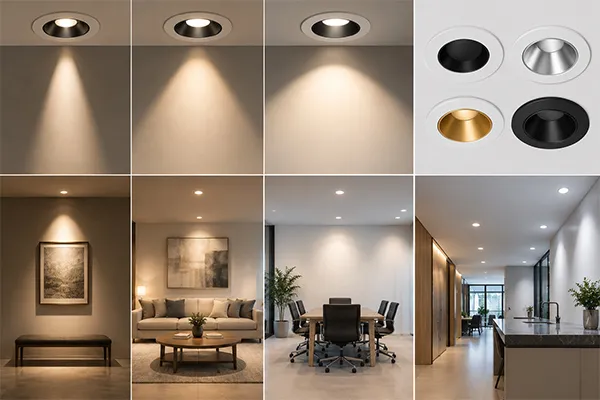
Buyers should specify LED downlights according to the lighting task rather than choosing by wattage alone. Key factors include required light level, lumen output, beam angle, color temperature, CRI, glare control, ceiling height, trim finish, dimming method, and the surrounding environment. Qualified designers should confirm lighting calculations for application-specific projects.
Wattage Does Not Describe the Whole Result
Wattage tells buyers how much electrical power a fixture consumes. It does not fully explain how the space will look5 or whether the fixture will perform the required task. Two LED downlights with the same wattage can produce different useful results because they may have different optics, drivers, LED packages, thermal designs, and light distributions.
When we discuss OEM or ODM requests with importers, contractors, and local lighting brands, we usually ask questions such as:
- What is the ceiling height and ceiling construction?
- What type of activity takes place below the fixture?
- Is the goal general ambient light, accent light, wall washing, or task lighting?
- What is the existing cut-out diameter?
- Is the project sensitive to glare?
- Does the customer require dimming, emergency operation, or smart controls?
- Which color temperature is expected in the target market?
- What CRI level is appropriate for the goods, finishes, or interior environment?
Core Specification Areas to Compare
| Specification | Why it matters | Buyer question |
|---|---|---|
| Lumen output | Influences the amount of delivered light | Does the output suit the ceiling height and lighting task? |
| Beam angle | Controls light spread and spacing | Is a narrow, medium, or wide distribution required? |
| Color temperature | Changes the visual atmosphere | Does the project need warm, neutral, or cool white light? |
| CRI | Affects color appearance | Are retail products, artwork, food, or interior finishes color-sensitive? |
| Driver | Influences stability and control compatibility | Is the driver suitable for the local voltage and dimming system? |
| Trim and finish | Affects visual integration | Does the trim match the ceiling and interior style? |
| IP rating | Relates to environmental protection | Is the location dry, humid, dusty, or exposed to water? |
Consistency Matters for Product Lines
For distributors and lighting brands, the decision is not limited to one project. They may need a series of LED downlights that work together across residential, hospitality, retail, and commercial channels.
A product line may need several cut-out sizes, wattages, color temperatures, trim colors, and beam angles while maintaining a consistent appearance. At Upward Lighting, we provide OEM/ODM options for parameters such as wattage, CCT, beam angle, CRI, and surface finish. However, buyers should document the agreed specification clearly and request relevant samples before large-scale purchasing.
I have seen how a small change in trim color or color temperature can become important once a distributor places the product in a showroom or supplies it to multiple branches. A controlled sample-approval process helps reduce those avoidable inconsistencies.
What Retrofit Risks Should Buyers Check Before Installing LED Downlights?
Retrofit projects can fail when buyers assume that a new fixture will fit and operate exactly like the old one. Existing ceilings, wiring, transformers, dimmers, and cut-out sizes can create installation issues that are not visible in a product catalog.
Before replacing traditional lighting with LED downlights, buyers should check cut-out dimensions, ceiling depth, supply voltage, driver arrangement, dimmer compatibility, wiring condition, heat dissipation, and local electrical requirements. A site survey and qualified electrical review can identify issues before fixtures are ordered or installed.
The Existing Ceiling Sets Practical Limits
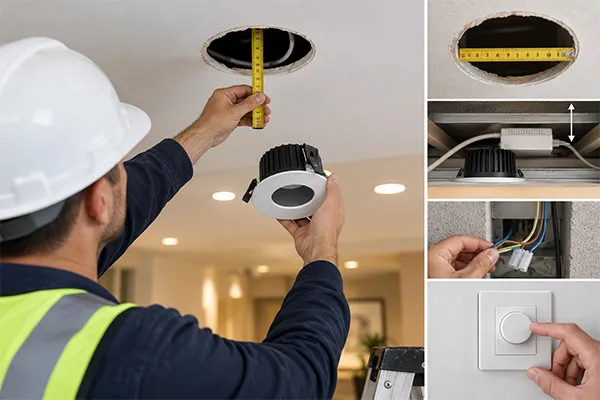
A recessed fixture must physically fit the ceiling opening and available void space. A project may have an existing cut-out of 90 mm, 120 mm, or 150 mm, while the desired replacement model may require another size. Buyers should not rely only on a nominal diameter shown in a listing.
They should measure:
- Existing cut-out diameter
- Ceiling thickness
- Ceiling cavity depth
- Available space around ducts, pipes, and insulation
- Spring-clip clearance
- Driver placement space
- Access for future maintenance
Some LED downlights include separate drivers. Others use integrated designs. Both arrangements can be appropriate, but the installation team must have enough room to position the driver safely and manage wiring without crushing cables or blocking ventilation.
Electrical and Control Compatibility Needs Verification
Electrical conditions vary by market, building age, and application. A fixture designed for one voltage range or control method may not work correctly in another project.6 Buyers should confirm the local supply voltage and frequency, as well as any requirements for dimming, sensors, emergency circuits, or control systems.
Common retrofit risks include:
- Using a dimmable LED downlight with an incompatible legacy dimmer
- Reusing unsuitable transformers from older low-voltage lamp systems
- Installing a fixture where heat cannot dissipate adequately
- Selecting a non-dimmable driver for a controlled lighting circuit
- Assuming an existing wiring method meets current local requirements
- Failing to check whether insulation or other materials affect fixture installation
We recommend that qualified electricians, engineers, and project designers review application-specific electrical conditions. We do not treat product datasheets as a substitute for local code review or professional site assessment.
Heat Management Is a Quality Issue
LEDs produce less wasted heat than many traditional light sources, but heat still affects LED components and drivers.7 A recessed downlight installed in a restricted ceiling void or near unsuitable insulation may experience conditions different from a laboratory test environment.
Buyers should ask suppliers about the fixture construction, recommended installation environment, and available test documents. They should also conduct representative site trials when the project has high operating hours, enclosed ceilings, demanding temperatures, or difficult maintenance access.
At our factory, every product undergoes a 100% aging test for 4 to 8 hours before shipment. This process supports shipment quality control, but buyers should still evaluate samples under their own installation conditions. Factory testing and project suitability are related, but they are not the same thing.
Why Do Buyers Prefer LED Downlights for Long-Term Procurement Planning?
Traditional lighting categories can be familiar, but procurement teams increasingly need products that can adapt to changing projects, customer preferences, and market requirements. A standardized LED platform can provide more specification choices while helping buyers simplify their supplier and inventory strategy.
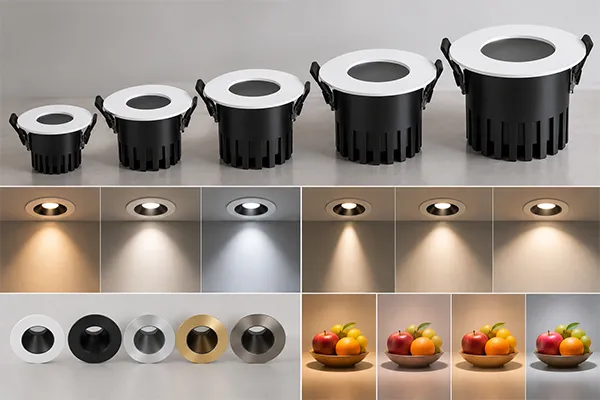
Buyers often prefer LED downlights for long-term planning because LED platforms can offer configurable wattage, color temperature, beam angle, CRI, trim finish, and packaging options. This flexibility is useful only when the supplier can demonstrate stable quality control, clear documentation, responsive communication, and dependable production planning.
Configurability Supports Different Sales Channels
A contractor may need a specific cut-out size for a renovation. A distributor may need three color temperatures for local stock. A lighting brand may need a custom trim color and private-label packaging. These needs are more difficult to manage when procurement is limited to a rigid, one-size-fits-all product.
For that reason, LED downlights can support more adaptable product planning. Typical configurable elements include:
- Wattage or power range
- Color temperature, such as warm, neutral, or cool white
- Beam angle
- CRI selection
- White, black, gold, or other trim finishes
- Driver and dimming options
- Packaging and branding
- Small-batch trial orders for new product lines
At Upward Lighting, we work with overseas contractors, importers, wholesalers, distributors, traders, and local lighting brands on these types of requirements. Our team can provide quick quotations and support small-batch orders, which can help buyers test a market before committing to a larger program.
Documentation and Quality Checks Remain Essential
More options do not automatically mean lower risk. Every customization creates another specification that must be controlled. Buyers should keep a product approval record that includes photos, drawings, key parameters, packaging requirements, and sample confirmation.
A practical supplier evaluation checklist should include:
| Evaluation area | What buyers should verify |
|---|---|
| Product specification | Wattage, CCT, CRI, beam angle, dimensions, driver type, and finish |
| Quality process | Aging tests, incoming-material control, inspection procedures, and traceability |
| Market documents | CE, RoHS, and other required documents for the target market |
| Sample consistency | Whether approved samples match production specifications |
| Communication | Quotation speed, technical response, and change-control process |
| Supply capability | Lead time, MOQ, spare-part planning, and capacity for repeat orders |
| Packaging | Carton protection, labeling, barcodes, and private-label requirements |
We provide CE and RoHS documentation for relevant products, but buyers should verify that certificates, declarations, test reports, and product markings match the exact product model and target-market requirements. Market-entry requirements can vary, and project compliance should always be confirmed locally.
Frequently Asked Questions
Are LED downlights always better than traditional lighting?
No. LED downlights can offer useful advantages for many recessed lighting applications, but they are not automatically the best choice for every fixture or space. Buyers should consider the lighting task, installation conditions, maintenance access, controls, local requirements, and the quality of the proposed product.
Can I replace a traditional downlight with the same wattage LED downlight?
We do not recommend watt-for-watt replacement as the only selection method. Buyers should compare useful lumen output, beam angle, ceiling height, glare, color temperature, and the intended lighting task. The new fixture must also fit the cut-out, electrical arrangement, and dimming system.
What should I check before ordering LED downlights for a retrofit?
Buyers should check cut-out size, ceiling depth, voltage, wiring, dimming compatibility, driver location, heat conditions, and required certifications. A representative sample installation can help identify risks before a large order.8 Qualified electricians should review electrical and local compliance requirements.
How can distributors reduce quality risk when sourcing LED downlights?
Distributors can reduce risk by approving samples, documenting specifications, checking factory quality-control procedures, reviewing relevant certification documents, and agreeing on packaging and labeling. They should also ask how the supplier manages repeat orders, product changes, spare parts, and long-term availability.
Are CE and RoHS documents enough for every market?
Not necessarily. CE and RoHS may be relevant to certain market-entry expectations, but requirements differ by country, project type, electrical system, and customer contract.9 Buyers should verify the documents for the exact model and consult local regulations, project specifications, and qualified professionals.
Conclusion
Traditional lighting is being replaced by LED downlights because buyers are looking beyond fixture price and considering lifetime maintenance, installation risk, product consistency, and supply continuity. The strongest procurement decision is not a simple watt-for-watt swap. It is a documented evaluation of light performance, retrofit compatibility, driver quality, certifications, and supplier capability. If you are sourcing customizable LED downlights for a project, distribution program, or private-label range, we invite you to contact Upward Lighting for samples, specifications, and a practical quotation.
"Purchasing Energy-Efficient Light Bulbs", https://www.energy.gov/cmei/femp/purchasing-energy-efficient-light-bulbs. U.S. Department of Energy materials document that LEDs can provide high efficacy and long operating life relative to conventional lamps, reducing energy use and potentially reducing relamping and associated maintenance. Evidence role: general_support; source type: government. Supports: Government evidence that LED lighting generally uses less energy and has a longer service life than many conventional lighting technologies, which can reduce relamping needs.. Scope note: Actual savings, maintenance outcomes, and replacement risk depend on the fixture, operating hours, controls, thermal environment, and installation. ↩
"[PDF] LIFE CYCLE COST ANALYSIS GUIDELINES", https://dial.iowa.gov/media/7432/download?inline. National Institute of Standards and Technology guidance defines life-cycle cost analysis as an economic method that evaluates costs incurred over an asset's life rather than considering purchase price alone. Evidence role: definition; source type: government. Supports: An authoritative definition of life-cycle cost analysis that includes acquisition, operation, maintenance, replacement, and disposal costs.. Scope note: The methodology supports the evaluation framework, not a conclusion that every LED retrofit will have the lowest lifecycle cost. ↩
"Arranging luminaires - Lighting knowledge", https://www.erco.com/en_us/designing-with-light/lighting-knowledge/lighting-design/arranging-luminaires-7645/. Lighting-design instructional materials explain that luminaire beam distribution and spacing determine the overlap of light on the working plane, so a narrow beam used without suitable spacing can create nonuniform pools of illumination. Evidence role: mechanism; source type: education. Supports: Lighting-design principles showing that beam spread, mounting height, and fixture spacing influence illuminance distribution and uniformity.. Scope note: Whether the result is perceived as harsh depends on the room geometry, surface reflectances, target illuminance, and user expectations. ↩
"Color rendering of light sources", https://www.nist.gov/pml/sensor-science/optical-radiation/color-rendering-light-sources. International lighting terminology and color-science guidance explain that the chromatic characteristics of an illuminant, including correlated color temperature, influence the visual appearance of illuminated surfaces. Evidence role: mechanism; source type: institution. Supports: Technical evidence that the spectral characteristics and correlated color temperature of illumination affect the visual appearance of illuminated objects and spaces.. Scope note: Color appearance also depends on spectral power distribution, color-rendering properties, surrounding colors, and observer adaptation. ↩
"Realization of the lumen", https://www.nist.gov/pml/sensor-science/optical-radiation/realization-lumen. U.S. lighting guidance distinguishes watts, which measure electrical power, from lumens, which measure emitted visible light; fixture optics and distribution further affect illumination in a space. Evidence role: definition; source type: government. Supports: The distinction between watts as electrical power and lumens as luminous flux, along with the relevance of distribution and application conditions to perceived lighting.. Scope note: Lumen output alone also does not fully predict visual comfort or task performance without an application-specific lighting design. ↩
"[PDF] dim LEDs with phase-cut dimmers - Pacific Northwest National Laboratory", https://www.pnnl.gov/main/publications/external/technical_reports/pnnl-22945.pdf. Industry technical guidance on LED controls reports that compatibility between the LED driver and dimmer or control system is necessary to avoid outcomes such as flicker, unstable operation, limited dimming performance, or failure to operate. Evidence role: mechanism; source type: institution. Supports: Technical guidance that LED drivers and controls must be compatible and that mismatches can cause flicker, limited dimming range, instability, or failure to operate as intended.. Scope note: Compatibility must be verified for the specific driver, dimmer, wiring arrangement, and local electrical supply. ↩
"Impact of Thermal Dissipation on the Lighting Performance ...", https://pmc.ncbi.nlm.nih.gov/articles/PMC8776062/. LED thermal-management research indicates that elevated operating temperature can accelerate degradation and reduce the reliability or useful life of LEDs and associated electronic drivers, despite LEDs' lower radiant heat output than many conventional sources. Evidence role: mechanism; source type: research. Supports: Research and technical guidance showing that junction and ambient temperatures influence LED light output, color stability, and component reliability, including driver reliability.. Scope note: Thermal effects vary substantially with the LED package, heat sink, driver design, enclosure, ambient temperature, and duty cycle. ↩
"Trial Demonstration of Area Lighting Retrofit", https://www.energy.gov/documents/gateway-yumapdf. Energy-efficiency retrofit guidance recommends field verification and commissioning to confirm that installed lighting equipment and controls perform as intended under actual site conditions, helping reveal issues not apparent from product documentation alone. Evidence role: general_support; source type: government. Supports: Retrofit and commissioning guidance recommending field verification of equipment performance, controls, and installation conditions before or during project deployment.. Scope note: A limited sample installation may not capture all conditions across a large or diverse project. ↩
"CE marking", https://en.wikipedia.org/wiki/CE_marking. European Commission guidance explains that CE marking applies only to products covered by relevant EU harmonisation legislation and that RoHS restricts specified hazardous substances in electrical and electronic equipment within its scope. Evidence role: historical_context; source type: government. Supports: Official European Commission information on CE marking obligations and the RoHS restriction framework for electrical and electronic equipment placed on the EU market.. Scope note: This source addresses EU legal frameworks and does not determine compliance obligations in non-EU markets or under a particular project contract. ↩